In our previous post, we showed how our MCP framework removes the friction from exposing system capabilities to AI.
MCP solves access. Cognition requires meaning.
Because enterprises don’t think in systems.
They think in business concepts.
The Limits of System-Level Intelligence
Most MCP servers today expose a single system — ERP, WMS, OMS, planning engines — often multiple instances of each.
This is useful — but incomplete.
When an AI asks:
“What is the status of this order?”
A system-level answer sounds like:
- “SAP says it’s billed”
- “WMS says it’s partially shipped”
- “OMS says it’s on hold”
The AI is left to reconcile contradictions.
That’s not intelligence.
That’s arbitration.
The Enterprise View: How Humans Actually Work
Humans don’t ask:
“What does SAP think?”
They ask:
“What’s going on with this order?”
They expect:
- A single answer
- Grounded in multiple systems
- Abstracted from implementation details
This is the level where cognition begins.
The Natural Next Step: Business Services
We extended our MCP framework to operate at the business-service level.
Instead of exposing systems, we expose enterprise concepts:
- GetOrder
- CheckAvailability
- CommitInventory
- PlanWork
Each service may:
- Call multiple systems
- Execute in parallel
- Reconcile differences
- Return a unified, enterprise-level truth
To the AI, it doesn’t matter where the data came from.
What matters is what the concept means.
A Cognitive Shift, Not a Technical One
This is more than integration.
It’s a cognitive shift.
Cognitive systems require:
- Stable concepts
- Consistent semantics
- Observable outcomes
- Feedback loops
You cannot reason, plan, or optimize on top of fragmented system views.
By exposing enterprise semantics through MCP, we give AI something it can finally reason over.
MCP as Cognitive Infrastructure
At this point, MCP stops being just a protocol.
It becomes cognitive infrastructure.
It enables a closed loop:
- Observe enterprise state
- Interpret context
- Plan actions
- Execute across systems
- Observe outcomes
This loop is the foundation of:
- Autonomous planning
- Continuous optimization
- Adaptive operations
In other words: cognitive enterprises.
Smart Cognitive Infrastructure: What it Looks Like in Practice
Refer to our MCP Framework overview. We explained there how we can create intents for any system easily. We support accessing any system via REST API, SQL, or Blue Yonder MOCA language. That infrastructure removes the inherent friction in publishing the APIs.
We took that abstraction further where we introduced a new player called “Enterprise”.
In our framework, “Enterprise” is a first-class system — not a wrapper, not a façade.
This system has a special trick up its sleeve — it interprets the intent and then maps to corresponding intent in every system in the enterprise. And then it executes that intent on every system in parallel.
We can easily normalize the results using our “sql” API. Thus sql becomes the semantic normalization layer — where system-specific outputs are reconciled into enterprise meaning.
I am including some screenshots from our framework below. This isn’t a chatbot demo. It’s a live enterprise cognition demo.
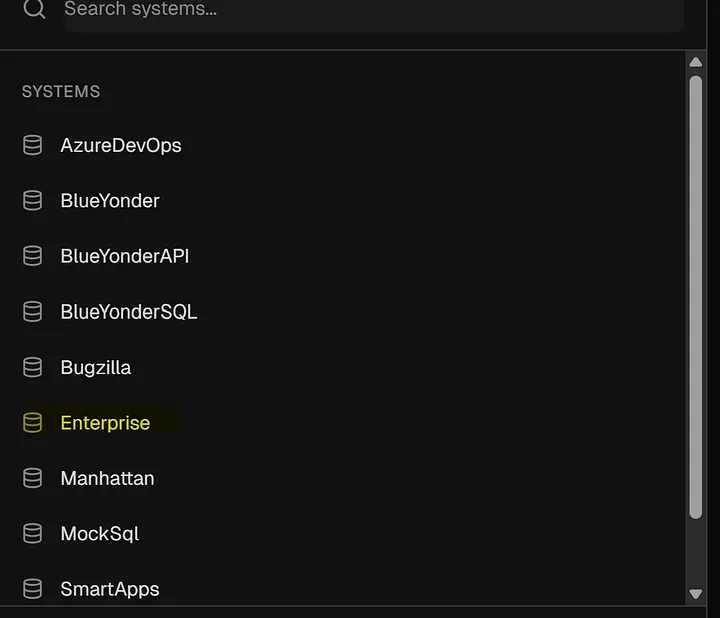
Here we see all systems that are part of the “Enterprise”. The intent is defined for the Enterprise using the concepts we described earlier where we provide its input, output, and description. Then we implement this enterprise intent for every participating system using the appropriate technology for that system. Our “sql” primitive function provides a powerful mechanism to enhance the published result and conform to the enterprise vocabulary.
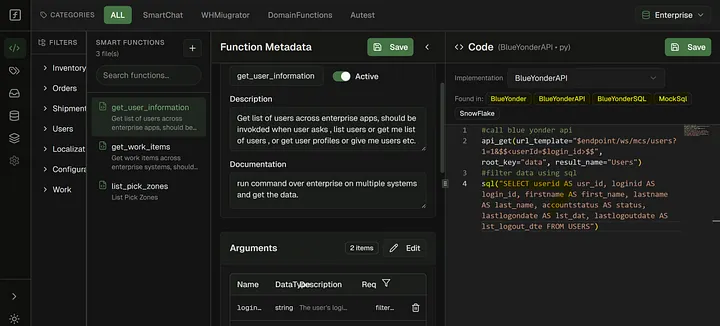
And that's it!
Now when any client (e.g. LLM) would ask a question spanning the whole enterprise, this MCP framework would respond with a coherent truth by getting the data from the whole enterprise in real time and in parallel.
How Our Solution Comes Alive?
As mentioned in our previous post, since every intent is published via MCP, we can use any client technology including:
- Open AI
- Microsoft Copilot
- Claude
Additionally note that since we completely abstract MCP we support other routes to access these capabilities as well, such as:
- Blueyonder native screen
- Smart IS provided chat solution
- Teams
I am showing our chat solution to demonstrate the capability of the enterprise adapter:
We select the enterprise assistant first
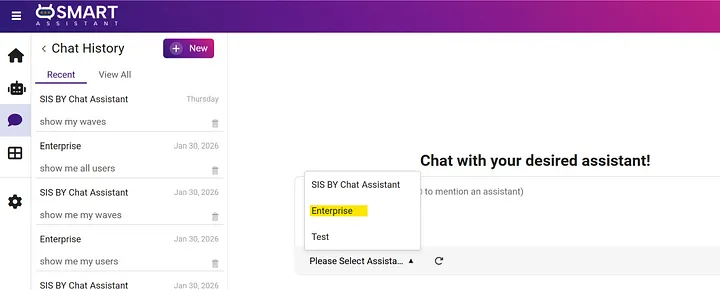
Now my query runs across the enterprise:
show me all the users
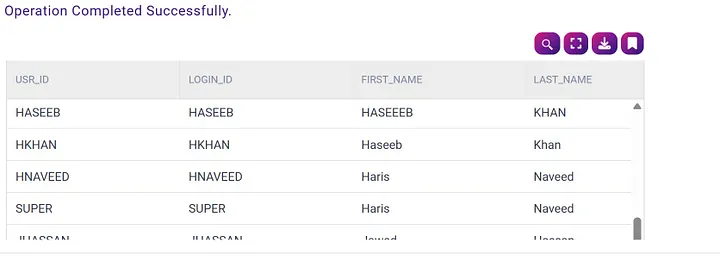
To see multiple systems in action, I asked:
For all users that exist on multiple systems, show user id, last name, first name, and list of systems as a comma-separated list
The response is generated properly:
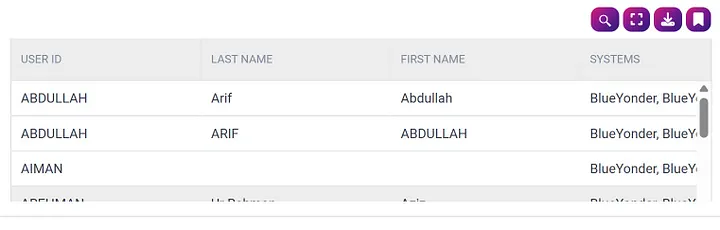
And I can always ask
What did you do?
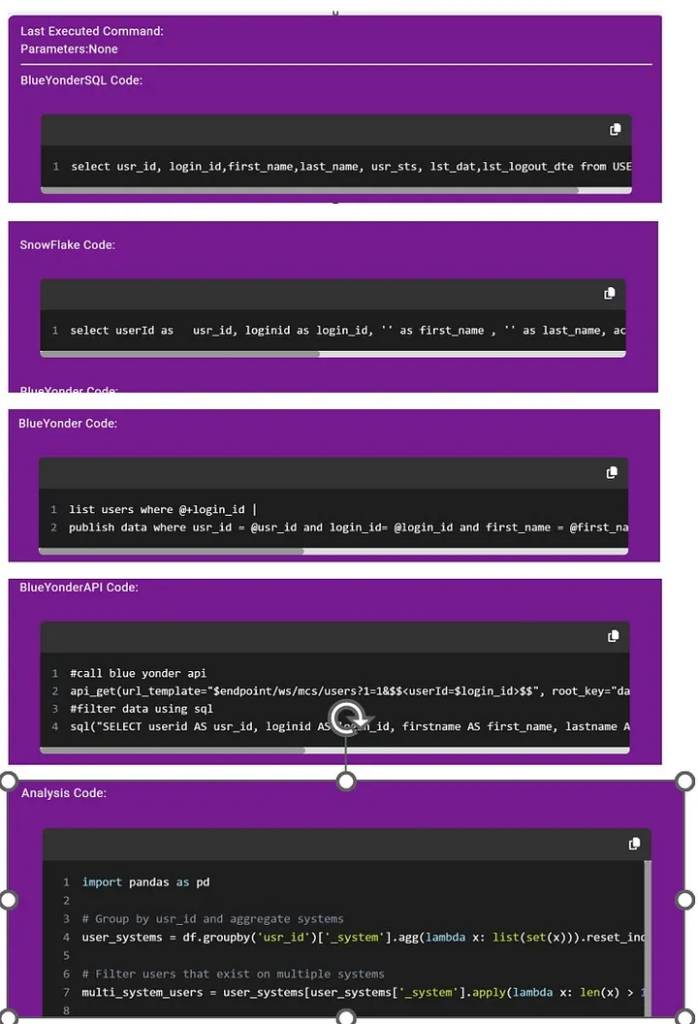
We can see from above how we easily published our enterprise data that was sourced from multiple systems. This demonstrates how we have easily established the foundation of a robust cognitive framework.
Environment Comparison — Interesting Use Case
Once intents can execute across environments, entirely new operational workflows become trivial.
One such use case is comparing different environments to see if some business data is misconfigured or missing.
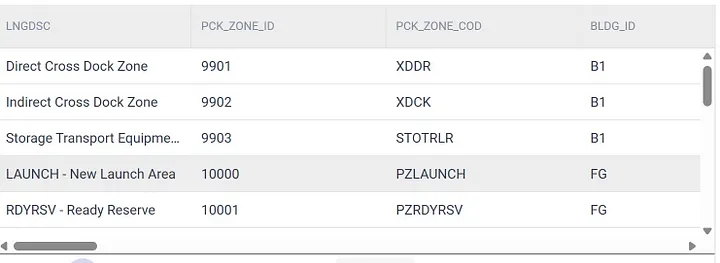
I defined an intent using the framework to get the pick zone data from Blue Yonder WMS. Note that I could get it using MOCA, SQL, or API.
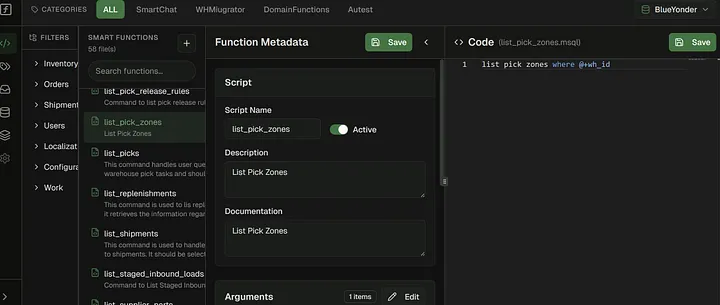
To get the pick zones across the enterprise (multiple environments), I asked:
show pick zones for all warehouses and all instances
And it responded with
Now I can simply ask
From above, create a list of pick zone code, warehouse. And include instance as a column with y/n indicating that the data exists on that instance
And that's it — I get a nice output that tells me exactly what I needed:

This same pattern generalizes across enterprise data domains:
- Semantic data drift detection across environments
- Intent-driven data propagation
- Cross-entity consistency validation
The intelligence here isn’t in retrieving pick zones — it’s in understanding absence, presence, and inconsistency across environments.
Reasoning Without Data Movement
As mentioned in our previous post, the Enterprise system also supports an execution model where the LLM generates code — but never directly accesses the enterprise data.
In this mode, the LLM is used strictly for reasoning and intent generation. The generated logic is then executed entirely within the enterprise boundary, using the same MCP-published capabilities. At no point does enterprise data leave the system or become visible to the model.
This capability enables a phased adoption path. Organizations can begin by leveraging AI for planning and orchestration, while maintaining full control over data execution and exposure. As trust and confidence grow, they can selectively enable richer data-sharing scenarios to unlock deeper cognitive behavior.
Why Sharing with AI Unlocks More Value
When enterprise data is shared with the LLM, the system crosses a critical threshold — from intelligent assistance to true cognition.
In our previous post, we used the following prompt as an example:
What is today’s situation, any risks , priory orders, etc. also share any recommendations to optimize anything Let me know your thought on risks , and recommendations etc.
In a single system, this kind of question can produce interesting insights. At the enterprise level, it becomes useful and actionable.
With enterprise-level MCP services, the AI can:
- Access multiple systems simultaneously — including mutually competing platforms such as Blue Yonder WMS and Manhattan WMS
- Understand customer demand, inventory position, inbound supply, and execution constraints across the enterprise
- Reason holistically about trade-offs and risks
- Recommend where and how work should be executed
Routing orders to the most appropriate execution platform becomes a real, automated possibility — not a manual exception process.
And critically, this happens without a massive integration initiative or a centralized data migration. The systems remain independent. MCP provides the semantic layer that allows AI to reason across them as a coherent whole.
Why This Couldn’t Come First
Enterprise-level cognition is not something you can design upfront. It only works because the first step existed.
You can’t federate what isn’t published.
You can’t abstract what isn’t accessible.
You can’t reason over what isn’t stable.
Most enterprise AI initiatives fail here — not because the ideas are wrong, but because the foundation never materialized.
By removing inertia at the system level and making participation frictionless, our MCP framework establishes that foundation. Once capabilities are published, stable, and semantically consistent, enterprise-level cognition stops being aspirational and becomes achievable.
From AI Assistants to AI Operators
Most AI systems today are assistive by design:
- Answering questions
- Summarizing data
- Suggesting actions
They inform humans — but they don’t operate the business.
Enterprise-level MCP unlocks something fundamentally different:
- AI that plans
- AI that operates
- AI that adapts
By giving AI stable enterprise concepts and observable outcomes, we enable a closed cognitive loop — observe, reason, act, and learn.
Not by replacing systems —
but by finally understanding them the way businesses do.
Closing Thought
Cognitive systems don’t emerge from bigger models. They emerge from better abstractions.
Our MCP framework starts by simplifying participation — making it easy for systems to become AI-ready. From there, it evolves naturally into a foundation for enterprise-level cognition.
This is not a leap of faith.
It’s a sequence.
And it’s the journey we’re building toward.
Our MCP framework starts by simplifying participation.
And it evolves naturally into a foundation for enterprise cognition.
That’s the journey we’re building toward.
Want to learn more about our MCP framework or explore enterprise cognitive solutions?
Visit Smart IS or reach out to me directly at saad.ahmad@smart-is.com.