Welcome to Above & BYond!
The Blue Yonder WMS world has many interesting opportunities for sharing knowledge, discussing common approaches to solutions, and navigating best practices.
As the application has progressed over the years and even changed its name a few times, it has remained the same at its core. So, whether you are using the most up to date application such as BY WMS 2020, an older version like Red Prairie 2007, or anything in between, the core concepts discussed in our webinar series remain relevant to everyone. Tune in to learn more about how you can take your Blue Yonder implementation further with BY Insights!
Episode 01: BY Insights into Integrator
Featuring Saad Ahmad, Executive VP of Smart IS
On this Episode of Above & BYond: BY Insights Into Integrator, Saad Ahmad discusses Integrator Core Concepts, Data Dictionary, Development & Methodology, as well as Troubleshooting & Performance Tips.
Episode 01: FAQs
Saad Ahmad Answers your Questions
It will not clear integrator cache. Integrator cache is kept in internal memory structure of the native processes and is cleared only when native process bounces or explicit MOCA command is called for clearing integrator cache.
- Read text file directly using notepad etc. Do not underestimate the power of notepad and vi
- Read in BY provide trace viewer
- Our preference: read in Smart MOCA Client trace viewer. This has a nice viewer and also allows loading to the database
- The competing product for “Smart MOCA Client” called “Lexedit” has a very nice trace viewer as well.
- Sl_dwnld is created, for example, when the file is dropped in the folder
- Sl_ifd_data_hdr and sl_ifda_dtl are created when sl_dwnld moves to ID status. Say it is one order with 3 order lines. Sl_ifd_data_hdr will have 1 row and sl_ifd_data_dtl will have 4. Sl_ifd_data_dtl.ifd_id, ifd_ver, ifd_seg_id will be populated
- Event is logged
- Eo is created (sl_eo_data_hdr/sl_eo_data_dtl)
- Result IFD is created (sl_ifd_data_hdr/sl_ifd_data_dtl). Same tables as #b but different ifd_id, ifd_ver, ifd_seg_id.
- This result IFD has “processing algorithm” that has the “create order” and “create order line” calls.
- So when the result IFD is sent that means that order and order lines have been created in ord and ord_line tables
That is a much broader question and it gives us an idea that we need a webinar on security in general. Integration specifically has a very narrow security exposure. Sure if someone sent an “order file” that looks valid to send that new Samsung TV to their home, that order may be fulfilled but that is more of an academic scenario rather than a real one. But general questions about controlling database access, security setup for users, LDAP, etc. are interesting topics. Broadly speaking
- You can (and should) set up users in BY such that passwords are in LDAP
- If passwords are setup in BY they are encrypted using strong one-way encryption techniques. Exact algorithms are proprietary (e.g. regarding salt etc)
- The database password is stored in the registry as an encrypted value. That is not one-way encryption since BY needs to decrypt it. That is a proprietary encryption algorithm and secure.
- It is a single file on a server in case you want to periodically change it.
- Databases must be set up for point in time recovery [full recovery model] and backups should be moved to offline storage that is not mounted on the servers so that ransomware does not spread to backups. But in case of ransomware attacks, these backups would be the only way to recover.
- Connections to BY application should be done using “HTTPS” and the MTF connections over SSL.
- Setup the registry parameters so that passwords do not appear in trace files.
Setup security on the server so that adhoc access (WinMSQL, server command operations, Smart MOCA Client, Lexedit) cannot access servers when not allowed. If a MOCA Client does not support this functionality, its use must be officially not allowed (corporate policies, procedures, and audits)

Episode 02: Reach For The Cloud
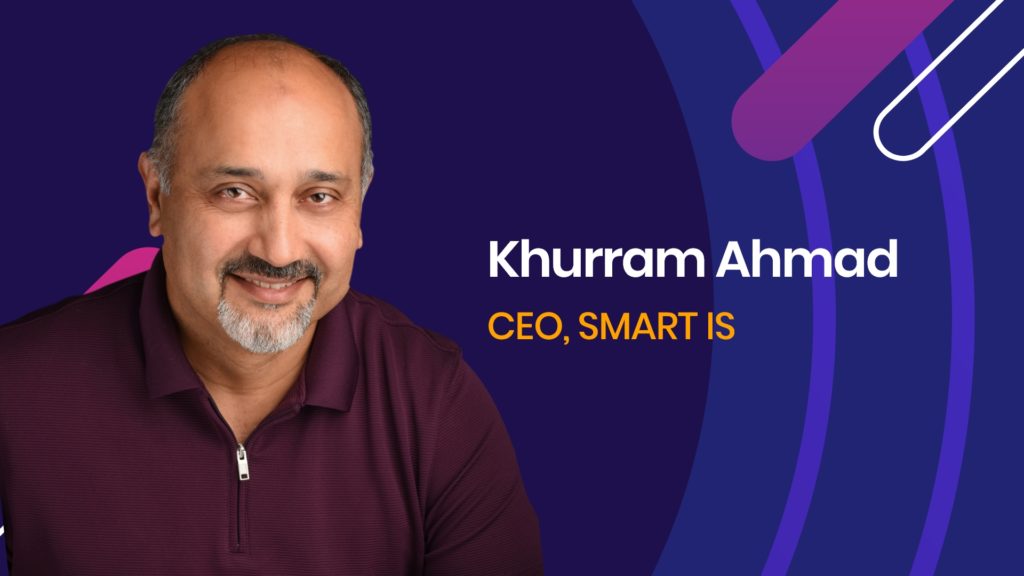
Featuring Saad Ahmad, Executive VP and Khurram Ahmad, CEO of Smart IS
On this Episode of Above & BYond: Reach for the Cloud, Saad Ahmad and Khurram Ahmad discuss the BlueYonder WMS Architecture, My Cloud and Cloud Reality Check. Let’s untangle the web of transforming your WMS to cloud.
A founder of Smart IS with over 20 years of supply chain experience specializing in BY/JDA/RedPrairie WMS. Khurram’s experience ranges from full complex multi warehouse implementations to upgrades with a vast knowledge base in integration, functional setup, MOCA and related systems. His integration experience covers all hosts including SAP, Oracle, BAAN, JDE and PeopleSoft.
Episode 03: Let’s Build
Featuring Saad Ahmad, Executive VP of Smart IS
Episode 04: Accelerate & Perform
Featuring Saad Ahmad, Executive VP of Smart IS
On this Episode of Above & BYond: Accelerate & Perform, Saad Ahmad will discuss core concepts, concept to console, performance tuning concepts, and tips.
Episode 05: Innovation BY Design
Featuring Saad Ahmad, Executive VP of Smart IS
On this episode of Above & BYond: Common Design Patterns, Saad Ahmad will discuss Blue Yonder concepts, abstraction, rule engines, and case studies.
Talk To Our Experts
Contact us to ask a question or setup a time to speak with one of our experts
Join Our Mailing List
Stay up to date on all things Above & BYond
Copyright © 2026 Smart IS International. All Rights Reserved.