






Transforming a Complex Legacy Landscape into a Scalable, Future-Ready Warehouse Platform
Abstract
In today’s rapidly evolving technology landscape, driven by continuous advancements in digital platforms, automation, and enterprise systems, organizations face increasing challenges in maintaining alignment between business operations and system capabilities. As warehouse management environments scale across multiple sites, the complexity of customizations, integrations, and operational variations grows significantly, making traditional, document-driven approaches to solution design increasingly ineffective.
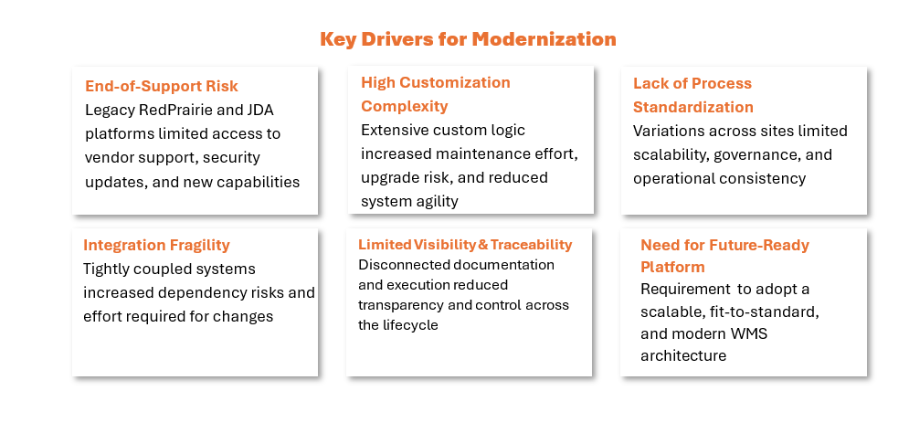
This case study presents how a global industrial manufacturing organization addressed these challenges during a large-scale Warehouse Management System (WMS) modernization initiative. The existing landscape, built on legacy RedPrairie and JDA platforms, had evolved into a highly customized and fragmented ecosystem, limiting scalability, visibility, and upgrade readiness.
To overcome these constraints, Smart IS implemented the Smart Solution Design Paradigm (SSDP), a capability-driven framework that connects design, development, testing, and deployment through a unified JIRA–Confluence ecosystem, enabling full lifecycle traceability and control.
This approach transformed the fragmented legacy environment into a standardized, scalable, and future-ready Blue Yonder WMS platform, effectively managing complexity and supporting sustainable transformation.
Client Overview
A global industrial manufacturing organization operating across multiple regions undertook a Warehouse Management System (WMS) modernization initiative to address growing complexity within its warehouse network. The existing landscape was built on legacy RedPrairie and JDA platforms, including versions such as RP WMS 2011 and JDA 8.2, deployed across more than 40 warehouse sites globally.
As part of the transformation, Smart IS conducted a structured assessment and identified approximately 800 capabilities spanning key warehouse operations. This highlighted the scale, fragmentation, and customization footprint of the existing environment, forming the foundation for a capability-driven WMS upgrade to Blue Yonder WMS 2021.
Smart IS Delivery Approach
To address these challenges, Smart IS executed a capability-driven transformation using the Smart Solution Design Paradigm (SSDP), a connected framework designed to align business processes, system design, development, testing, and deployment into a unified execution model.
In modern, large-scale transformation programs, traditional approaches relying on static documentation and siloed execution often lead to disconnects between business requirements, system design, and implementation. As solution complexity increases across multiple sites and systems, maintaining alignment, traceability, and control becomes increasingly difficult.
SSDP addresses this challenge by establishing a centralized and continuously connected solution ecosystem, built on the integration of JIRA and Confluence. Confluence serves as the central repository for solution design, business processes, and documentation, while JIRA manages development, testing, and deployment activities through structured workflows.
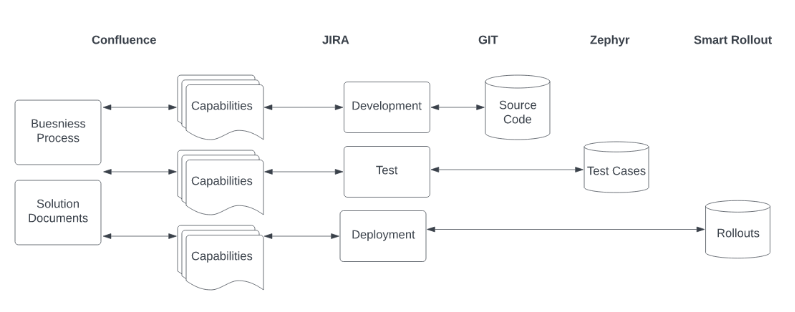
SSDP capability-driven execution model with integration of business processes, design artifacts, development, testing, and deployment through a unified JIRA–Confluence ecosystem.
The program was executed through a connected lifecycle, where each phase was inherently linked.
Assessment – Establish solution baseline and transformation roadmap
Design & Build – Translate requirements into structured solution implementation
Testing & Validation – Ensure alignment between business expectations and system behaviour
Deployment & Hypercare – Execute controlled rollout and stabilization
Assessment Phase: Establishing the Foundation
Within the Smart Solution Design Paradigm (SSDP), the Assessment phase established the foundation for the transformation by defining the capability model and execution baseline for all subsequent activities. Given the complexity of the WMS landscape—characterized by high customization, process fragmentation, and integration dependencies—a structured, data-driven assessment was essential to mitigate downstream risks.
This approach enabled Smart IS to clearly define scope and capability boundaries, identify key risks and dependencies early, rationalize customizations based on business value, and align requirements with target platform capabilities. By structuring outputs within a traceable, capability-driven framework, SSDP ensured continuous alignment across design, development, and testing—positioning the program as a controlled, business-aligned transformation rather than a traditional system upgrade.
Execution Approach
Smart IS executed the Assessment phase through a structured set of workstreams, combining stakeholder collaboration, system analysis, and capability-driven evaluation.
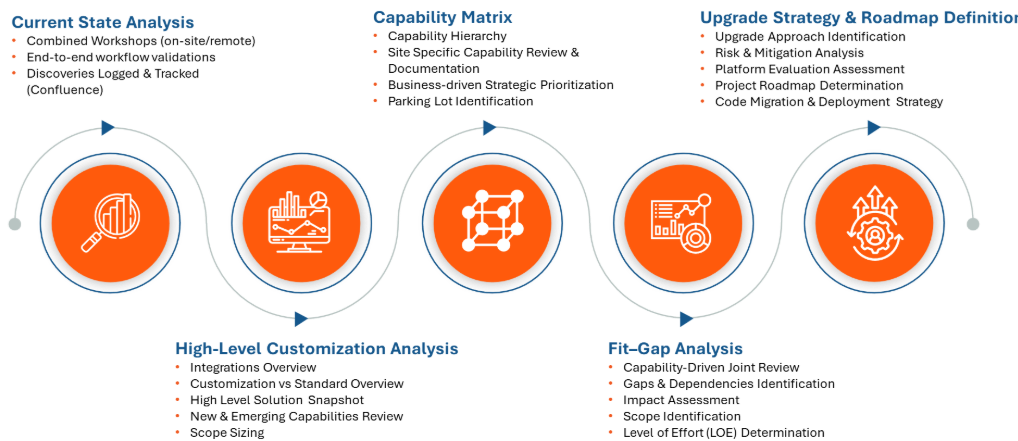
These activities were supported by a centralized JIRA–Confluence ecosystem, ensuring that all findings, decisions, and deliverables were documented, tracked, and continuously aligned.
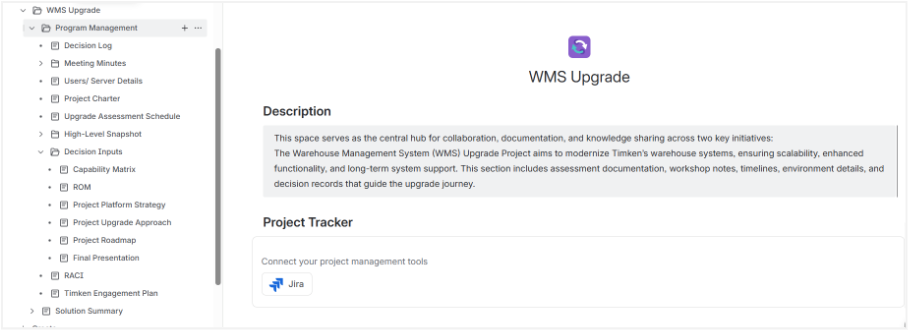
Following the current state and high-level analysis, Smart IS conducted a structured capability identification exercise across multiple warehouse sites, resulting in approximately 800 capabilities spanning key warehouse operations.
Through a detailed fit-gap analysis, around 350 capabilities were aligned with standard Blue Yonder functionality, while the remaining were identified as gaps requiring configuration, enhancement, or rationalization. Smart IS defined targeted solutions for these gaps, enabling alignment with a fit-to-standard architecture while preserving critical business requirements.
All capabilities were consolidated into a centralized Capability Matrix, enabling consistent evaluation, prioritization, and alignment across the transformation.
During this process, Wave Planning (Auto Waving) was identified as a critical capability within the Order Fulfillment domain. While the core Wave Planning functionality aligns with standard Blue Yonder features, associated capabilities such as batching logic, grouping rules, and execution triggers were analysed and structured as part of the solution design. These were categorized under the Wave Planning domain to ensure alignment between business requirements and system implementation.
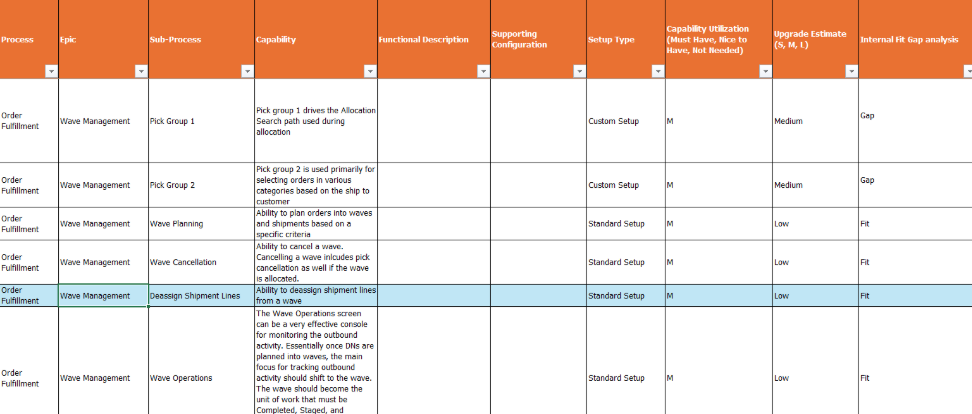
Assessment Outputs & Decisions
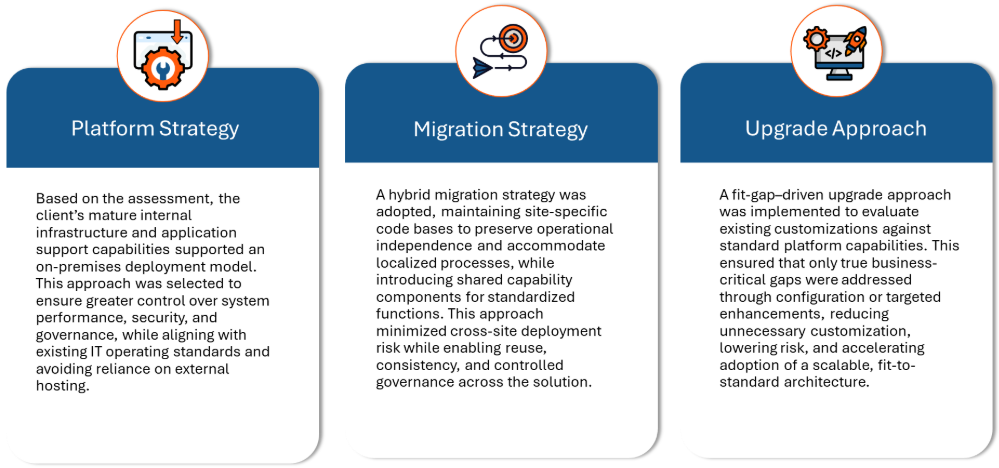
Based on these insights, Smart IS defined the following key strategic decisions:
Design & Build: Translating Capabilities into Execution
Building on the structured capability model established during the Assessment phase, Smart IS transitioned into the Design & Build phase, where identified capabilities were translated into detailed solution components and implementation artifacts.
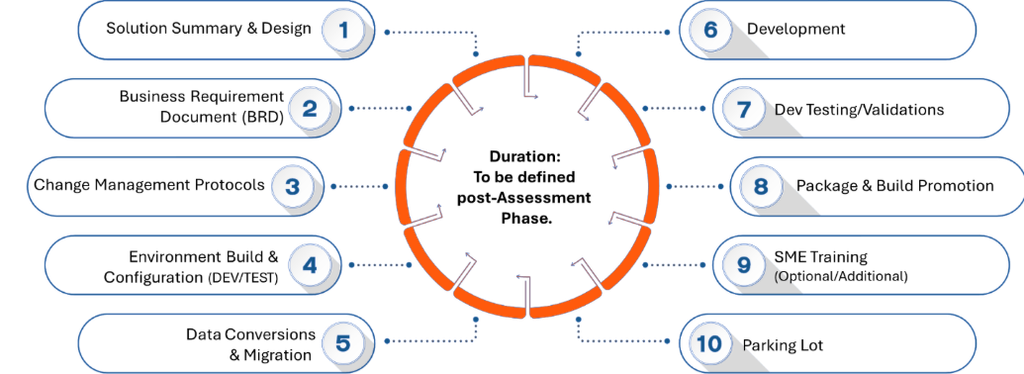
Within the SSDP framework, design and development activities were not executed in isolation. Instead, each capability was directly linked to its corresponding business processes, configuration design, and technical implementation within a centralized Confluence–JIRA ecosystem.
Capability-Driven Design Execution
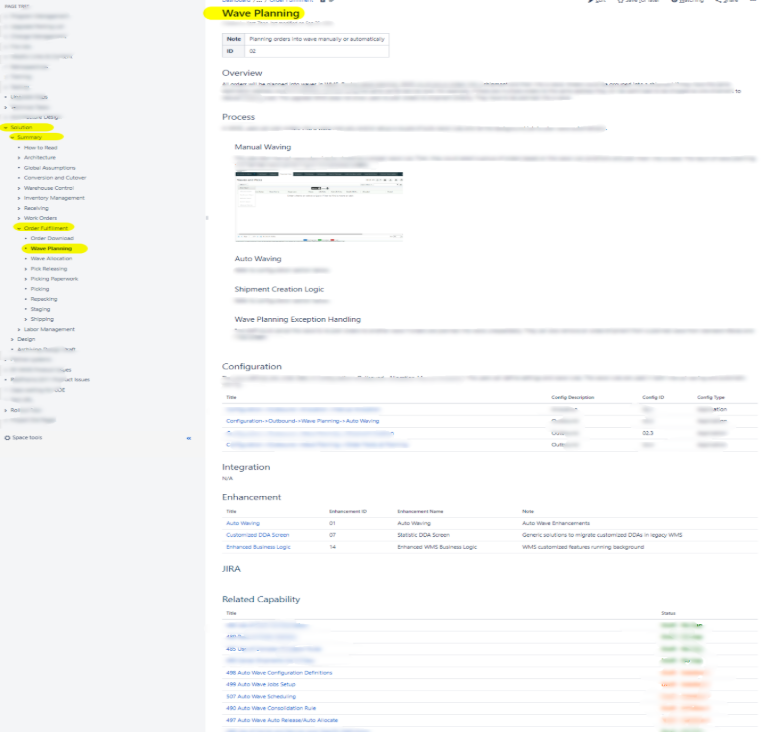
For the Wave Planning (Auto Waving) capability, the design approach focused on leveraging standard Blue Yonder functionality while structuring and rationalizing associated custom logic identified during assessment.
All Auto Waving capabilities were documented and structured within Confluence as dedicated capability pages, capturing:
- Business process flows and operational usage
- Configuration details and setup parameters
- Identified enhancements and controlled extensions
- Integration dependencies and related capabilities
Technical Design & Implementation Alignment
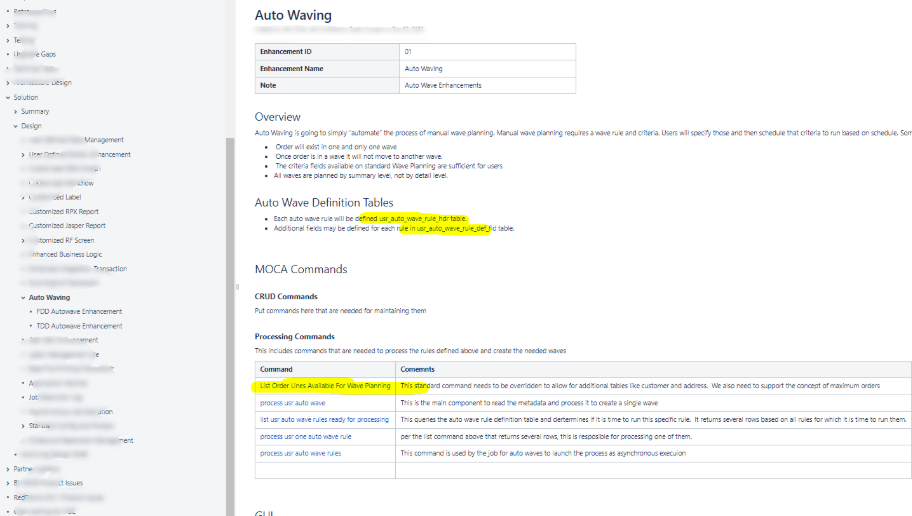
From a technical perspective, Auto Waving capabilities were consolidated into a unified and structured design framework, ensuring consistency and adaptability across sites.
This included:
- Definition of underlying tables and configuration structures
- Standardization and rationalization of MOCA command logic
- Alignment of processing rules for wave creation and execution
By linking technical design elements directly within Confluence, Smart IS ensured that design artifacts remained continuously synchronized with system implementation, eliminating the need for disconnected technical documentation.
JIRA-Driven Development & Traceability
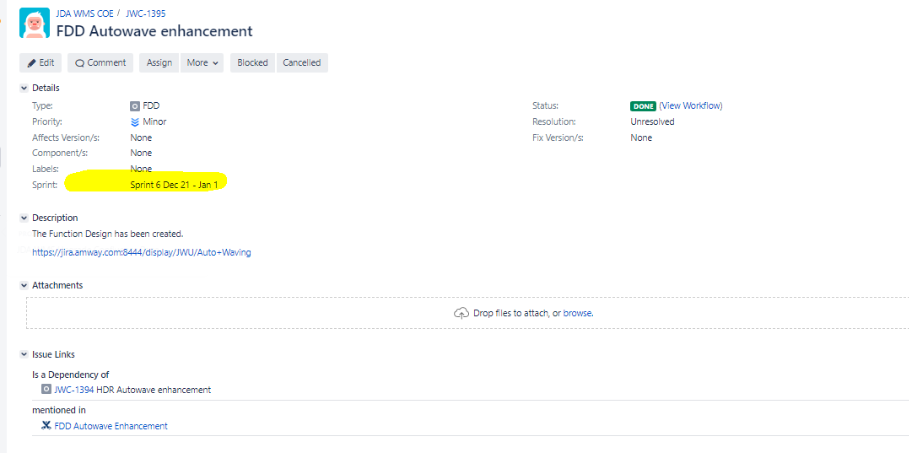
All design components were linked to JIRA tasks, enabling structured development and real-time tracking. Each capability was managed through a central Header JIRA, with tasks executed through sprint cycles and all deliverables mapped back to the originating capability.
This ensured end-to-end traceability, real-time visibility into progress, and controlled execution aligned with defined scope and priorities.
Testing & Validation: Capability-Driven Assurance
Following the Design & Build phase, Smart IS transitioned into Testing & Validation to ensure that all implemented capabilities performed as expected and aligned with defined business requirements.
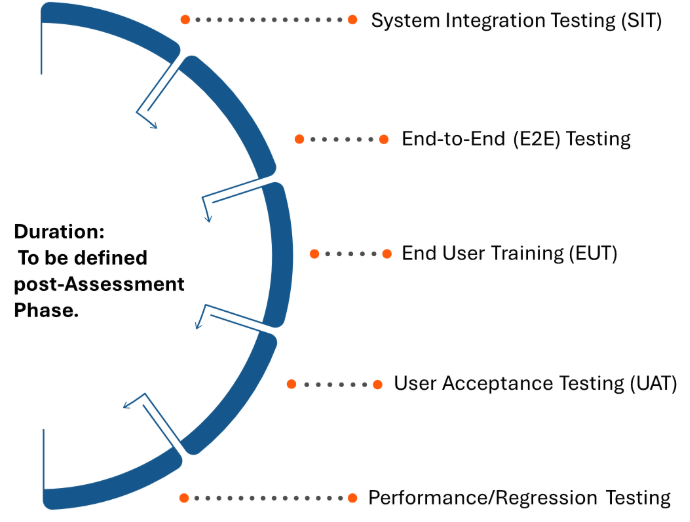
Consistent with the Smart Solution Design Paradigm (SSDP), testing was executed in a capability-driven and traceable manner, where each test scenario was directly linked to its originating capability, design artifact, and corresponding JIRA task.
Capability Validation – Auto Waving
For the Wave Planning (Auto Waving) capability, testing focused on validating execution behaviour and business outcomes across different operational scenarios.
This included:
- Validation of wave creation logic based on defined rules and triggers
- Verification of batching, grouping, and scheduling behavior
- Testing of configuration-driven scenarios across multiple conditions
- Ensuring consistent execution across sites aligned with business expectations
Each test scenario was mapped back to the capability and associated JIRA task, ensuring end-to-end traceability and complete coverage.
Integrated Testing Execution & Automation
Testing was executed collaboratively with business stakeholders and SMEs, ensuring continuous validation and feedback throughout the phase.
- Test cases were derived from business processes and mapped to capabilities
- Execution and defect tracking were managed through JIRA
- Defects were linked back to capabilities for structured resolution and impact analysis
To enhance efficiency and coverage, Smart IS leveraged accelerators such as AuTest to enable automated regression testing across key warehouse processes, significantly reducing manual effort and cycle time while improving the consistency and repeatability of test execution.
Deployment & Hypercare: Controlled Execution
Following successful validation, Smart IS transitioned into Deployment & Hypercare, executing a controlled and structured rollout to ensure a seamless transition to production.
Aligned with the Smart Solution Design Paradigm (SSDP), deployment was carried out in a capability-driven and traceable manner, where all release activities were directly linked to corresponding capabilities, JIRA tasks, and approved deliverables.
Capability-Driven Deployment – Auto Waving
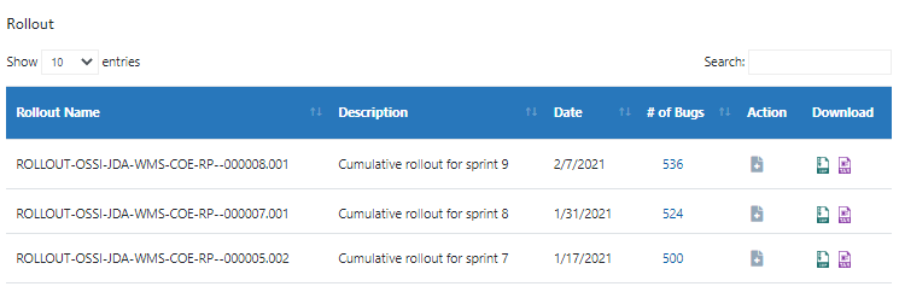
For the Wave Planning (Auto Waving) capability, deployment was managed through structured rollout packages, ensuring that all validated configurations and enhancements were consistently promoted across environments.
Deployment packages were generated and managed as sprint-based rollouts, with each release linked to its originating capabilities and tracked through JIRA. This ensured controlled execution, clear visibility into deployment progress, and alignment with defined approval workflows.
Hypercare & Stabilization
Post-deployment, Smart IS provided structured Hypercare support to ensure system stability and rapid issue resolution.
- Continuous monitoring of system performance and operations
- Rapid resolution of production issues and defects
- Close collaboration with business stakeholders for validation and feedback
All issues identified during Hypercare were tracked through JIRA and linked back to capabilities, ensuring continued traceability and structured resolution.
Connected Delivery & Lifecycle Traceability
Across all phases, from Assessment through Design, Testing, and Deployment, the program was executed as a connected, capability-driven lifecycle, ensuring continuous alignment between business requirements, solution design, and execution.
The Smart Solution Design Paradigm (SSDP) enabled this by transforming static documentation into a continuously maintained, living solution model. Through the integration of Confluence and JIRA, all artifacts—from requirements and design to development, testing, and deployment—remained centrally managed, traceable, and aligned in real time.
This approach provided end-to-end visibility, seamless traceability from requirement to implementation, and a structured, scalable delivery model, eliminating the risk of outdated documentation and ensuring continuous alignment throughout the transformation lifecycle.
Success Matrix
The success of the WMS modernization program was measured across key operational, technical, and delivery dimensions, demonstrating tangible improvements in standardization, efficiency, and execution control.
| Dimension | Success Criteria | Outcome Achieved |
| Process Standardization | Alignment of warehouse processes across sites | Standardized inbound, outbound, and inventory workflows across multiple locations |
| Customization Reduction | Reduction in custom-built logic | Significant reduction in non-value customizations through a fit-to-standard approach |
| Traceability & Governance | End-to-end visibility across lifecycle | Full traceability from capability → design → development → testing → deployment |
| Upgrade Readiness | Alignment with modern platform capabilities | Successfully aligned solution with latest Blue Yonder WMS architecture |
| Development Efficiency | Controlled and structured execution | Capability-driven development improved delivery predictability |
| Testing Effectiveness | Improved validation coverage and efficiency | Capability-based testing and automation reduced manual effort and improved coverage |
| Deployment Stability | Reduced risk during go-live | Phased rollout approach minimized operational disruption |
| Operational Visibility | Improved monitoring and decision-making | Enhanced transparency across operations and system behavior |
| Scalability & Future Readiness | Support for future growth and enhancements | Modular, standardized architecture enabled scalability and adaptability |
Conclusion
The WMS modernization program demonstrates how a complex, highly customized warehouse landscape can be transformed into a standardized, scalable, and future-ready platform through a capability-driven approach.
By leveraging the Smart Solution Design Paradigm (SSDP) and integrating tools such as JIRA and Confluence, Smart IS enabled continuous alignment between business requirements, system design, and execution—ensuring end-to-end traceability and controlled delivery across the lifecycle.
This transformation not only addressed immediate challenges around customization and fragmentation but also established a robust, scalable foundation for future growth, reinforcing that successful modernization is driven by a connected execution model, not technology alone.