






For the past couple of years, we’ve seen a massive push toward Specialized LLMs. The argument seems intuitive: if you need legal expertise, use a legal model. If you need medical expertise, use a medical model. Why rely on a “general” model when you can have one trained specifically for the task at hand?
In the short term, that logic makes perfect sense.
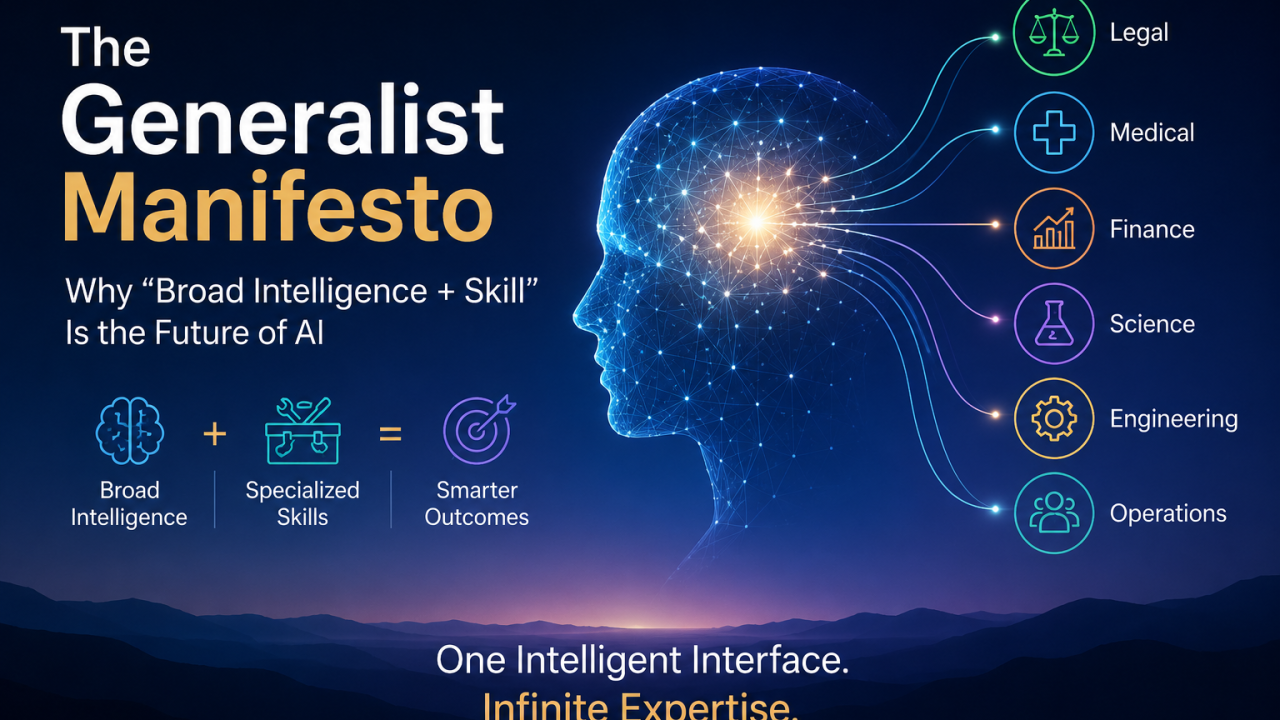
But over the long term, the future of AI is unlikely to be thousands of separate specialist interfaces competing for our attention. Instead, the future will belong to General Intelligence paired with dynamically applied skills and specialized capabilities behind the scenes.
The distinction matters.
The question is not whether specialized intelligence will exist. It absolutely will. The real question is whether humans should have to think about it at all.
1. The Education Analogy: Liberal Arts + Professional Certification
Think of a General LLM as someone with a strong 4-year liberal arts education. They have broad reasoning ability, communication skills, contextual understanding, and the ability to learn across disciplines.
A Specialized LLM is more like a focused professional certification or technical specialization. It is optimized deeply for a particular domain.
Neither is “better” in isolation.
In many cases, the specialist will outperform the generalist within a narrow task. But the long-term advantage belongs to the broadly intelligent system that can dynamically acquire and apply specialized skills when needed.
The modern economy already works this way. The most adaptable professionals are often those with broad foundational reasoning who can layer specialized expertise on top as circumstances evolve.
AI will likely follow the same path.
This matters because some of the most valuable insights do not come from staying inside a single discipline.
Imagine asking an AI a legal question about intellectual property in the age of generative AI. A narrowly specialized legal model might provide statutes, precedent, and case summaries. All of that is useful.
But a broadly intelligent system may recognize that the deeper issue resembles older debates from art, science, and even biology:
- How do societies treat derivative creation?
- Where is the boundary between inspiration and replication?
- How does evolution itself “borrow” successful patterns?
It may connect copyright law to the history of collage in modern art, to open-source software movements, or even to how scientific progress builds incrementally on prior discovery.
The legal answer becomes stronger precisely because the intelligence was not trapped inside law alone.
That is the hidden power of broad reasoning paired with specialized skill: the ability to transfer insight across domains rather than merely optimize within one.
In the future, a General AI may silently invoke dozens of highly specialized subsystems:
- legal reasoning modules
- mathematical engines
- medical retrieval systems
- optimization solvers
- enterprise workflow agents
But the user should not need to decide which system to talk to.
Just as we do not manually choose which database index executes a query, users should not need to route themselves through a maze of specialist AI interfaces.
The intelligence layer should handle that complexity for us.
2. The Infrastructure Analogy: The Office 365 Shift
We have seen this pattern before in enterprise technology.
In the early days of cloud computing, organizations insisted that sensitive workloads would always remain on local infrastructure. Many believed cloud platforms could never become trusted enough for mission-critical operations.
Yet over time, unified platforms won.
Not because specialized systems disappeared, but because the abstraction layer became more valuable than the underlying fragmentation. Security improved, scale improved, integration improved, and the convenience of a unified interface became impossible to ignore.
Today, most users no longer think about:
- storage clusters
- mail server topology
- replication architecture
- failover infrastructure
They simply use the platform.
AI is moving in the same direction.
The long-term value will not come from forcing users to pick between hundreds of narrowly specialized models. It will come from intelligent orchestration layers that invisibly combine broad reasoning with specialized execution.
3. The Architecture Analogy: Query Optimizers and Invisible Complexity
Modern software succeeds by hiding complexity.
When you search for information in a database, you do not manually choose:
- which partition to query
- which index to invoke
The database optimizer handles that for you.
AI will evolve similarly.
The General LLM becomes the orchestration layer—the system that understands intent, context, and desired outcomes. Behind the scenes, it may invoke highly specialized engines for:
- symbolic mathematics
- compliance validation
- scientific simulation
- supply chain optimization
- transactional execution
But those systems increasingly become infrastructure rather than destination interfaces.
As users, we should be interacting with intelligence—not plumbing.
The Verdict
Specialized intelligence is not going away.
If anything, the number of specialized AI systems may increase dramatically over time. But they will increasingly operate behind a unified layer of general reasoning and intent understanding.
The future is not a hundred disconnected AI applications demanding that users understand their boundaries and routing logic.
The future is an intelligent interface that understands intent, orchestrates specialized capabilities invisibly, and allows humans to focus on outcomes rather than systems.
Broad intelligence plus dynamically applied skill is not the rejection of specialization.
It is the abstraction of specialization.
Originally published at LinkedIn.