







Skip to content

Contact us

    Talk to our Experts


    +1 920 303 0470
    info@smart-is.com 1302 S Main ST , Oshkosh , WI 54902-6518

    The Power of Visuals

    When you listen to an RJ (Radio Jockey) on the radio, what you hear is just the audio, but your mind somehow creates an image of what the RJ must look like, or the studio they are sitting in. That is the power of visuals. 

    With the digital world booming, each form of multimedia is used in the most effective way by most companies and brands. 

    In order to create the most appeal, one needs to focus on the aspects that make the visual stand out in a unique way. There are many ways to do so: 


    The Rule of Thirds 

    In many portraits or products captured in landscape mode, you will notice that the subject often is not in the center, rather than on the side. That creates more of an impact than putting the subject in the middle; the negative space increased, putting more focus on the visuals. 

    It is a great tool that can be incorporated for brands that require photography, social media designs, corporate videos, and interviews. 

    Just remember not to place the subject too much on the side – use grids to help create a balance between the negative space and the subject!

    Foreground Vs. Background 

    A current trend with social media is designing minimal posts that seem to gather more attention than designs that look very busy. How does minimalism gather more attention? 

    One major technique is creating a difference between the foreground and the background. That can be done in many ways: 

    First is creating a contrast between the two, commonly seen in UI design for buttons and menu bars.  

    Second is to highlight the distance between the foreground and background, with the use of shadows and lighting. A popular example is of portrait and product photography where the focus is on the subject, and the background is blurred, creating both depth and focus.

    Finally, the use of color is an important factor in creating impactful art. For a typical minimal post design consisting of a background and text, just using 2 complimentary colors can add a lot of value and impact in the final result.  


    Framing 

    <br
    Believe it or not, framing is not just a concept limited to photography and videography, but also designs and animation. There are multiple elements to look at when creating your frame; in the case of an animation, each frame needs to be thoroughly checked. 

    A lot of theoretical knowledge needs to be factored in when creating a frame:  

    The positioning, the right use of negative space, the sizing, the colors, and symmetry. Layering is also an important element, where the designer can add impact to the frame by adding a foreground object in front of the subject, or in the background.  

    Texture & Detailing 

    With more and more design tools available online, there are increasing ways of highlighting your content – textures and detailing is one of them. But there is a fine line between slight details added to your subject, and overusing textures or shadows to make your design unappealing. In this case, less is more! 

    Hence when creating shadows and highlights, remember to let it blend in and not enhance it too much. Same goes for textures. Textures can make or break your art. Even with photography – an example of a poorly edited photograph is when sharpness has been excessively added to the subject, making it look unattractive. So, use these tools wisely!  

    These are just some of the important points I believed should be considered when creating a powerful visual – the possibilities however are endless. Design mediums have now increased dramatically, from UI/UX design, to social media design, print design, photo and video, animation and so much more. Make sure to research thoroughly before any project, and do your best! 

    Leave a Reply

    Your email address will not be published. Required fields are marked *

    Recent Stories

    View All
    S
    Smart Solution Design Paradigm (SSDP): A WMS Modernization Case Study 
    Sep 24, 2026

    Transforming a Complex Legacy Landscape into a Scalable, Future-Ready Warehouse Platform  Abstract  In today’s rapidly evolving technology landscape, driven by continuous advancements in digital platforms, automation, and enterprise systems, organizations face increasing challenges in maintaining alignment between business operations and system capabilities. As warehouse management environments scale across multiple sites, the complexity of customizations, integrations,

    Read More
    USD 78 mil millones en oportunidad. Una pregunta crítica: ¿Pueden los almacenes de América Latina mantener el ritmo? 
    Sep 22, 2026

    Según el Banco Interamericano de Desarrollo (BID), el nearshoring podría generar aproximadamente USD 78 mil millones adicionales en exportaciones anuales en América Latina y el Caribe. Para fabricantes, retailers y distribuidores de la región, esto representa una de las oportunidades de crecimiento más importantes para la cadena de suministro en décadas.  Sin embargo, el crecimiento

    Read More
    Nearshoring y la brecha en la ejecución del almacén en Latinoamérica  
    Aug 06, 2026

    El nearshoring está transformando las cadenas de suministro globales y posicionando a América Latina como uno de sus principales beneficiarios. A medida que fabricantes y retailers acercan la producción y la distribución a los mercados finales, la inversión en la región continúa acelerándose.  Los datos de nearshoring y cadena de suministro mencionados a lo largo de este blog provienen de investigaciones

    Read More
    Blog Feature Image
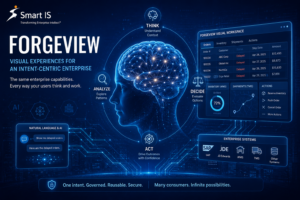
    ForgeViu: Visual Experiences for an Intent-Centric Enterprise
    Jun 12, 2026

    Technology has a habit of making us believe that every new breakthrough renders everything that came before it obsolete. When television became mainstream, many predicted the end of radio. When e-commerce emerged, some predicted the end of physical retail. When smartphones arrived, there were predictions that desktop computing would become irrelevant. Reality is usually more

    Read More
    Beyond the Crawl: A Coding Agent for Proprietary Programming Languages
    May 17, 2026

    General-purpose coding models perform well on languages that are well-represented on the public internet. They fail predictably on proprietary or domain-specific languages: hallucinated identifiers, wrong call shapes, and confident reproduction of deprecated patterns. MOCA, the scripting language inside Blue Yonder’s Warehouse Management System, is one of those failure cases, the entire ecosystem (grammar, command catalog,

    Read More
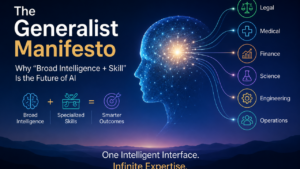
    The Generalist Manifesto: Why “Broad Intelligence + Skill” Is the Future of AI
    May 08, 2026

    For the past couple of years, we’ve seen a massive push toward Specialized LLMs. The argument seems intuitive: if you need legal expertise, use a legal model. If you need medical expertise, use a medical model. Why rely on a “general” model when you can have one trained specifically for the task at hand? In

    Read More
    Safety by Ignorance vs Safety by Understanding: What the Claude–DoD Debate Is Really About
    Apr 03, 2026

    There is a growing debate in AI governance that is often framed as a dispute over “safeguards,” “alignment,” or “responsible AI.” A recent flashpoint involves models developed by Anthropic (notably Claude) and the U.S. Department of Defense, but the disagreement is deeper than any single vendor or contract. At its core, the debate is not

    Read More
    From Chat to Capability: Operationalizing Enterprise AI Intents
    Apr 02, 2026

    In earlier posts, I argued two related ideas: This post builds directly on those ideas and takes the next logical step. If intent is the real abstraction — and if enterprises need repeatable, governed intelligence — then the obvious question is: Where does intent actually live, and how does it execute? The Missing Layer: Intent

    Read More
    Enterprise Cognitive Intelligence, Without the Complexity
    Feb 17, 2026

      In our previous post, we showed how our MCP framework removes the friction from exposing system capabilities to AI. MCP solves access. Cognition requires meaning. Because enterprises don’t think in systems.They think in business concepts. The Limits of System-Level Intelligence Most MCP servers today expose a single system — ERP, WMS, OMS, planning engines —

    Read More
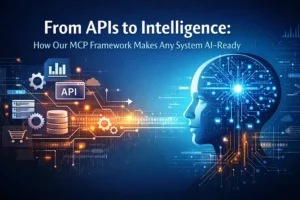
    From APIs to Intelligence: How Our MCP Framework Makes Any System AI-Ready
    Feb 17, 2026

    Everyone wants to “add AI” to their systems — but few succeed. Not because AI models aren’t powerful — they are. But because exposing enterprise systems to AI is still too hard. So for most teams, the friction is simply too high. A Useful Analogy: AI as a Researcher Think of AI as a researcher. At

    Read More