
Skip to content

Contact us

    Talk to our Experts


    +1 920 303 0470
    info@smart-is.com 1302 S Main ST , Oshkosh , WI 54902-6518

    AI Defense: The Intersection of AI, Politics, and Fake News

    In an era dominated by the digital dissemination of information, the concept of ‘fake news’ has been a consistent concern. Coupled with the rapidly advancing realm of AI, an issue emerges in the form of confusion, distrust, and the opportunity to claim AI as a defense. According to NewsGuard, an organization that tracks misinformation, they have so far identified 976  AI-generated news and information sites operating with little to no human oversight and are tracking false narratives produced by AI tools.

    Navigating the issue of AI defense becomes complex at the intersection of politics, political campaigns, and the internet and social media landscape. This article explores the implications of AI defense, the challenges of regulating AI use in politics, and the strategies needed to protect businesses and maintain trust in media.

    Artificial Intelligence Security and Confusion

    Experts have been warning that AI confusion can affect how people perceive the reality of news on the internet. Recently, a growing group of politicians all over the world are claiming AI-created damning photos, videos, and audio are fake. Politicians ranging from former president Donald Trump to a ruling-party Taiwanese politician have used AI to absolve themselves in the face of embarrassing footage.

    In one case the claim was easily debunked as the videos were heavily featured in the news when it originally happened. The conclusion with the other case was not so obvious – it is unclear if the footage was AI-generated.

    Furthermore, deepfake videos are also becoming a significant concern in the context of AI-generated content and artificial intelligence security. Deepfakes are videos that use powerful AI algorithms to superimpose faces and manipulate voices, creating extremely convincing but entirely fabricated content. With the rise of deepfake technology, the possibility of misinformation and fake news has increased significantly.

    Challenges in AI Defense Strategies and Regulation

    While AI companies like OpenAI have said that their tools should not be used in political campaigns, enforcement is difficult. The company did recently ban a developer from using OpenAI tools after they created a bot for Democratic presidential candidate Dean Phillips. This was the first known action by them for a political campaign.

    However, even total enforcement by companies does not eliminate the existence of AI in politics. Open-source technologies exist that are not accompanied by any rules of use or enforcement capabilities. The potential misuse of AI in political campaigns has raised concerns for the regulation of AI use and AI Defense Strategies and Regulation.

    Recommended Reading: The AI Revolution

    The Dual-Edged Problem of AI in Cyber Defense

    AI in Cyber Defense has created a dual-edged problem. On the one hand, individuals can create AI-generated videos and audio of trusted public figures saying truly anything. On the other hand, the erosion of trust in video complicates holding accountable those public figures genuinely caught engaging in wrongdoing, as they can always leverage the plausible deniability afforded by AI.

    Furthermore, the ability and tech needed to check if a piece of media is fake is currently only in the hands of experts, while the tools to create AI content are available to almost anyone. The use of AI defense has consequently led to a significant decrease in trust in the video and audio content of public figures.

    Conclusion

    The intersection of AI, politics, and the digital realm presents a multifaceted challenge. The concern of ‘fake news’ in our information-dominated era is exacerbated by the advancements in AI technology. As politicians worldwide increasingly wield AI as a defense against damning media, the complexity of discerning truth from fiction intensifies. 

    Moving forward, technology companies and regulatory agencies should emphasize the need for accurate and user-friendly AI checkers to keep pace with the rapid advancements and widespread accessibility of AI generators. Without such tech, we risk hurtling towards a post-truth era where the traditional adage of “seeing is believing” no longer holds true.

    Leave a Reply

    Your email address will not be published. Required fields are marked *

    Recent Stories

    View All
    Nearshoring y la brecha en la ejecución del almacén en Latinoamérica  
    Aug 06, 2026

    El nearshoring está transformando las cadenas de suministro globales y posicionando a América Latina como uno de sus principales beneficiarios. A medida que fabricantes y retailers acercan la producción y la distribución a los mercados finales, la inversión en la región continúa acelerándose.  Los datos de nearshoring y cadena de suministro mencionados a lo largo de este blog provienen de investigaciones

    Read More
    Blog Feature Image
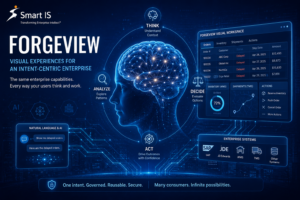
    ForgeViu: Visual Experiences for an Intent-Centric Enterprise
    Jun 12, 2026

    Technology has a habit of making us believe that every new breakthrough renders everything that came before it obsolete. When television became mainstream, many predicted the end of radio. When e-commerce emerged, some predicted the end of physical retail. When smartphones arrived, there were predictions that desktop computing would become irrelevant. Reality is usually more

    Read More
    Beyond the Crawl: A Coding Agent for Proprietary Programming Languages
    May 17, 2026

    General-purpose coding models perform well on languages that are well-represented on the public internet. They fail predictably on proprietary or domain-specific languages: hallucinated identifiers, wrong call shapes, and confident reproduction of deprecated patterns. MOCA, the scripting language inside Blue Yonder’s Warehouse Management System, is one of those failure cases, the entire ecosystem (grammar, command catalog,

    Read More
    The Generalist Manifesto: Why “Broad Intelligence + Skill” Is the Future of AI
    May 08, 2026

    For the past couple of years, we’ve seen a massive push toward Specialized LLMs. The argument seems intuitive: if you need legal expertise, use a legal model. If you need medical expertise, use a medical model. Why rely on a “general” model when you can have one trained specifically for the task at hand? In

    Read More
    Safety by Ignorance vs Safety by Understanding: What the Claude–DoD Debate Is Really About
    Apr 03, 2026

    There is a growing debate in AI governance that is often framed as a dispute over “safeguards,” “alignment,” or “responsible AI.” A recent flashpoint involves models developed by Anthropic (notably Claude) and the U.S. Department of Defense, but the disagreement is deeper than any single vendor or contract. At its core, the debate is not

    Read More
    From Chat to Capability: Operationalizing Enterprise AI Intents
    Apr 02, 2026

    In earlier posts, I argued two related ideas: This post builds directly on those ideas and takes the next logical step. If intent is the real abstraction — and if enterprises need repeatable, governed intelligence — then the obvious question is: Where does intent actually live, and how does it execute? The Missing Layer: Intent

    Read More
    Enterprise Cognitive Intelligence, Without the Complexity
    Feb 17, 2026

      In our previous post, we showed how our MCP framework removes the friction from exposing system capabilities to AI. MCP solves access. Cognition requires meaning. Because enterprises don’t think in systems.They think in business concepts. The Limits of System-Level Intelligence Most MCP servers today expose a single system — ERP, WMS, OMS, planning engines —

    Read More
    From APIs to Intelligence: How Our MCP Framework Makes Any System AI-Ready
    Feb 17, 2026

    Everyone wants to “add AI” to their systems — but few succeed. Not because AI models aren’t powerful — they are. But because exposing enterprise systems to AI is still too hard. So for most teams, the friction is simply too high. A Useful Analogy: AI as a Researcher Think of AI as a researcher. At

    Read More
    F
    From System Silos to System Intelligence: The AI Shift Enterprises Cannot Afford to Ignore
    Dec 10, 2025

    Enterprises today operate in an environment where systems multiply, data sits fragmented, and real-time decisions depend on information scattered across platforms. The divide between organizations’ need for instant, secure, conversational access to enterprise intelligence and their reliance on siloed screens, complicated integrations, and manual reporting processes is increasing each year.   According to a survey report

    Read More
    Why Traditional Deployment Playbooks No Longer Keep Up with Modern Warehouses
    Oct 30, 2025

    Modern warehouses are evolving faster than the deployment practices that support them. What was once a predictable, linear, and manual deployment cycle has turned into a complex, high-stakes process that no longer fits the pace of operations. Traditional deployment playbooks were designed for slower systems with fewer moving parts. Today’s warehouses operate across multiple sites,

    Read More