






Software was eating the world. Then we built something that began eating the world software created.
In 2011, Marc Andreessen declared that software was eating the world.
He was right.
Software transformed banking, retail, transportation, entertainment, and almost every industry it touched. For years, software companies were the predators. Everyone else was trying not to become their prey.
Then came generative artificial intelligence.
At first, the reaction was simple: Wow.
A machine could write a poem. Then an essay. Then a program. Soon it could build applications, investigate technical problems, and carry out work that once required entire teams.
Every new model felt like another victory. Every announcement promised a smarter, faster, more productive future.
But somewhere along the way, the excitement began to change.
The breakthroughs kept coming. So did their consequences.
AI began discovering vulnerabilities faster than organizations could fix them. The engineers who spent decades automating other professions began confronting automation themselves. And the companies building increasingly powerful AI found themselves spending fortunes creating intelligence their competitors were making cheaper.
At first glance, these seem like separate problems.
But look closer.
The very breakthroughs driving AI forward are beginning to undermine the industries, skills, and economic foundations that made those breakthroughs possible.
And every disruption creates pressure for another solution, another investment, another generation of AI.
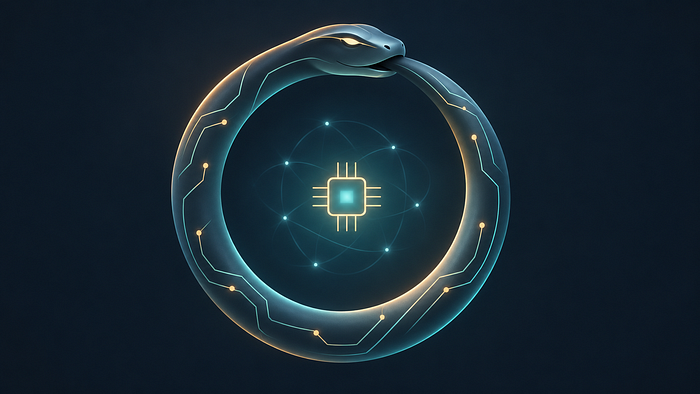
There is an ancient symbol for such a cycle: the Ouroboros, a serpent consuming its own tail. It represents not merely destruction, but renewal an ending that becomes the beginning of something else.
In late 2026, the technology industry seems caught in that very circle.
But whether the serpent is destroying itself or creating something new is becoming increasingly difficult to tell.
The Security Paradox: When Progress Became the Problem
Consider a developer trying to secure their own application.
They ask an AI coding assistant to examine it for vulnerabilities. The request is defensive, find the weaknesses before somebody else does. Then the system’s safety controls intervene. The model the developer chose is no longer available for the task.
This is no longer just a hypothetical scenario. For developers using AI assistants in everyday security work, it is becoming a familiar frustration. Even legitimate attempts to audit their own applications can trigger cybersecurity safeguards, causing flagship models like Opus 5.5 to fall back to older versions. Public reports from developers highlight the contradiction: the very tools meant to help secure software can end up standing in the way of those trying to protect it.
Anthropic says ordinary secure coding and source-code reviews are permitted, and that its controls aim to limit higher-risk offensive capabilities. Those are legitimate concerns. But false positives expose a difficult tension: a tool sophisticated enough to find danger may also be sophisticated enough to decide its user cannot investigate it.
And the scale of the work awaiting those users is growing.
We’ve barely emerged from what cybersecurity observers dubbed “Black October” , a month marked by a wave of serious security incidents and critical vulnerabilities, including PHP2Shell.
The scale was extraordinary. According to SOCRadar, 17,075 CVEs were published in October alone a staggering 299.5% increase over the same month in 2025.
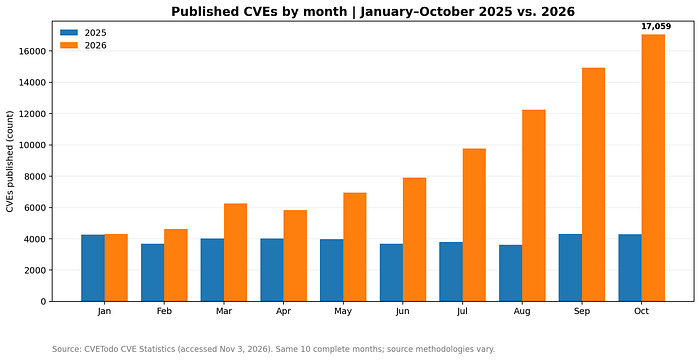
Not every vulnerability was discovered by AI, and automated reporting contributed to the surge. But the numbers reveal a cybersecurity landscape changing at a pace that traditional discovery and remediation processes are struggling to match.
We may be entering an era where machines can discover vulnerabilities faster than humans can understand, verify, and fix them.
Anthropic’s Project Glasswing revealed an even more important shift, Advanced AI could find serious flaws at a pace that made verification, disclosure, and repair the new bottleneck.
For decades, security researchers searched for needles in haystacks.
Now the machines are getting better at finding needles than organizations are at removing them.
So defenders adopt AI to find vulnerabilities faster. Attackers gain access to related capabilities. Defenders need still more AI to patch, prioritize, and protect their systems. Providers add stronger safeguards, which can sometimes interrupt legitimate defense.
The solution doesn’t end the problem. It changes the problem and creates demand for the next solution.
The serpent takes its first bite!
The People Who Built Automation Meet It Themselves
In October, a young computer-science graduate named Kiran Maya Sheikh finally landed her first full-time software engineering job.
Before that came months of applications, volunteer work, learning new skills, and uncertainty. She had chosen computer science partly for the stability it promised. Instead, she found herself struggling to enter an industry whose rules were changing before her career had even begun.
Her story had a hopeful ending. But elsewhere in the industry that same month, something else was happening.
On October 26, Microsoft offered voluntary exit packages to approximately 60,000 eligible employees , that is more than a quarter of its workforce.
These weren’t layoffs, nor proof that AI was replacing those employees.
But the timing was striking.
One of the companies leading the AI revolution, investing billions in technology designed to transform how work gets done, was simultaneously offering a substantial portion of its workforce the opportunity to leave.
And the transformation was already underway.
Just months earlier, Microsoft reported that one in three GitHub pull requests involved an AI agent.
An AI agent doesn’t need to replace an engineer entirely to change how many engineers a company hires or how many new graduates it needs.
In August, Stanford researchers had already reported growing employment pressure among younger workers in AI-exposed occupations. AI wasn’t established as the sole cause, but the findings raised an uncomfortable question about the future of entry-level work.
For decades, software engineers built tools that automated everyone else’s work.
Now they’re building AI that can automate parts of their own.
But perhaps the deeper concern isn’t simply losing jobs.
Engineers develop their craft by writing code, making mistakes, and learning from failures. But as AI makes software easier to create, future generations may begin questioning why they need to learn the science behind it at all.
If AI can write the software, will the next generation still learn how it works or could we end up in a world overflowing with code, where the craft of truly understanding it becomes a lost art?
The industry may be automating not just its own work, but part of the process through which its future experts are trained.
And once the cost of producing software changes, the consequences don’t stop with the people who write it.
They reach the companies selling it.
When the Customer Becomes the Competitor
In September, business operator Tony Bangert described looking at a HubSpot subscription and deciding to build his own customer management system. In his account, he tested the software, canceled the subscription, and eventually began offering versions of his system to other companies.
One person’s experience doesn’t mean every business can replace its enterprise software tomorrow. But it captures a question that would have sounded very different a few years ago.
Why are we paying for this when we might be able to build what we actually need?
For two decades, Software as a Service thrived on a simple formula: find a problem, build an application, host it, and charge a subscription. The difficulty of producing and maintaining reliable software was a competitive advantage.
AI is lowering that barrier.
A small team can now produce useful dashboards and internal workflows that once required a larger project. That isn’t the same as replacing a mature enterprise platform: security, integrations, regulatory obligations, support, and trust still count for a great deal.
But even if only a portion of the software market becomes easier to reproduce, the pressure is real.
So the established vendors respond by putting AI into their own products. They need to offer more value, faster. Their competitors are doing the same.
And there is the trap.
The technology SaaS companies use to defend their products is the same technology helping their customers and competitors build alternatives.
What looked like a defensive investment becomes another force changing the market.
The serpent takes another bite!
The Machine That Consumes Knowledge and Creates It
Imagine a publisher spending weeks on a useful guide. It gets researched, edited, fact-checked, and published. A reader asks Google a question the guide answers and sees an AI summary before ever reaching the site.
The reader may get exactly what they need. The publisher may never receive the visit.
This is no longer just a theoretical problem. Axios has publicly described the loss of search traffic affecting publishers, including itself, and the Reuters Institute has documented the industry’s efforts to adapt. Pew Research found that users encountering AI summaries were less likely to click ordinary search results.
Google built an extraordinary business around helping people find information. Search a question. See the links. Visit a page. Perhaps click an advertisement. Publishers gained readers, advertisers found customers, and Google sat at the center of that exchange.
Then AI offered something more convenient.
Why open ten pages if an assistant can answer in seconds?
Google had to respond. If it refused to change search, competitors would change it for Google. But the response brings a contradiction of its own.
The better search becomes at answering questions, the less reason some users have to visit the websites that supply those answers.
Google’s search business is still profitable and growing; the evidence does not support declaring it dead. Yet the companies publishing information face a different calculation. If visits become scarcer, they may publish less of the useful material the web depends on or focus on work that AI summaries cannot easily replace.
The search engine becomes better at the very thing that alters the ecosystem around it. One innovation solves the reader’s problem and creates the publisher’s next problem.
But there is another twist.
AI may no longer be limited to consuming and summarizing human knowledge. In September, OpenAI announced an AI-generated solution to one of mathematics’ most difficult problems, a remarkable claim that mathematicians are still scrutinizing.
The technology that depends on human knowledge may now be capable of contributing new discoveries of its own but discovering something and establishing it as knowledge are not the same. Someone must still verify it, challenge it, explain it, and make it trustworthy.
And that brings us back to the original paradox.
The serpent may be learning to replenish what it consumes. But what happens if, in the process, it weakens the very human ecosystem needed to make that knowledge trustworthy?
Cheaper Intelligence, More Expensive Machines
Imagine a PC enthusiast pricing a memory upgrade or a new graphics card. They aren’t training a foundation model or building an AI startup. They just want a better computer.
Yet they are shopping in a market transformed by AI data centers.
Memory shortages and rising component prices have pushed computer costs higher. In a survey of its own readers, Tom’s Hardware found many PC gamers delaying new builds as AI infrastructure absorbed enormous manufacturing capacity.
But here’s the irony.
While the machines needed to run AI are becoming more expensive, the intelligence those machines produce is becoming cheaper.
Model prices have fallen dramatically. Open-weight alternatives are becoming increasingly capable, and organizations with suitable hardware can now run useful AI models without paying a cloud provider for every request.
That creates a problem for the companies selling AI.
They are investing billions in chips, data centers, and energy to build increasingly powerful systems. Yet their customers are gaining access to cheaper alternatives, including models they can run themselves.
A rival lowers its price. An open model narrows the performance gap. A business decides that local AI is good enough for work it once paid to run in the cloud.
So the providers must offer something better, often at an increasingly competitive price.
But building something better requires more infrastructure, more investment, and more computing power.
The companies spending fortunes to create intelligence are helping create a world in which intelligence is increasingly difficult to sell at a premium.
And the consequences may extend far beyond the AI industry.
In November, Anthropic’s IPO disclosures revealed enormous long-term computing commitments while acknowledging that open-weight models could put pressure on its pricing.
Consider the contradiction.
AI companies need investors to finance increasingly expensive infrastructure. But those investors must believe that future customers will pay enough to justify the investment, even as competition keeps pushing the price of intelligence down.
What happens if those expectations don’t materialize?
This is no longer merely a theoretical concern. The International Monetary Fund warned in October that disappointing AI profitability could trigger a market correction, with risks extending through interconnected investments and financing arrangements.
An industry racing to make intelligence cheaper could find itself undermining the financial expectations supporting its own expansion.
The serpent grows larger with every bite, yet the more it consumes, the more it must feed just to sustain itself.
Nobody Can Afford to Stop
By now, the question is unavoidable.
If the race keeps creating new problems, why doesn’t anyone slow down?
Because nearly everyone fears what happens if they do.
The engineer worries about losing ground to another engineer using AI. The software vendor fears a smaller competitor. The publisher fears losing its audience. Google fears losing search. AI providers fear cheaper models. Hardware suppliers fear the alternatives their success inspires.
They are not all facing the same threat. But they are responding to the same incentive: move before somebody else moves first.
Safety work matters. Slowing particular deployments, setting standards, and coordinating research are real choices, not impossibilities. But the incentives remain painfully uneven.
Moving too fast can be dangerous. Moving too slowly can feel dangerous to the people and companies in the race.
And so each participant reaches for the tool that seems most likely to help: more AI.
The publisher turns to AI to recover the audience that AI-powered search is taking away. The engineer adopts AI to remain competitive, even as it automates more of their own work. The SaaS company integrates AI to defend its product, while making software easier for customers to build themselves. Security teams depend on AI to confront vulnerabilities that AI is increasingly capable of discovering and exploiting. And the AI labs invest billions in more powerful models, only to accelerate the competition that makes their previous breakthroughs cheaper.
Each is trying to protect its future by investing in the very technology disrupting it.
And every attempt to escape the cycle helps keep it turning!
What Grows Back?
We began with wonder.
A machine could talk. Then write. Then code. Then discover vulnerabilities hidden for decades. And now, it may even contribute to scientific discoveries once thought beyond the reach of machines.
Every breakthrough felt like another step toward a better future. And in many ways, it is…
But somewhere along the way, we began discovering that progress has consequences that progress itself cannot always resolve.
And perhaps the greatest irony is that these consequences aren’t necessarily signs of failure.
They are consequences of AI becoming extraordinarily successful.
The more capable the technology becomes, the more it reshapes the world that made it possible. And in our race to make machines increasingly intelligent, we risk overlooking the human expertise, judgment, and institutions that made those breakthroughs possible in the first place.
This is where the Ouroboros becomes more than a symbol of self-destruction. The serpent consumes its own tail, but the circle also represents renewal. What disappears makes room for something new.
Yet renewal is not a guarantee of improvement.
In 2011, software was eating the world.
In 2026, AI began eating the foundations that software had built and turning the consequences into fuel for its next advance.
The question is no longer whether the serpent will take another bite. It’s whether we’re preserving enough of what matters for something better to grow back.