







Every warehouse runs on decisions: where to slot incoming inventory, how to sequence outbound waves, when to reroute a pick path, or reprioritize replenishment. Most of these decisions are made within the constraints of deterministic logic: hard-coded rules, static optimization models, and workflows that assume yesterday’s volumes, labor, and demand profiles still apply today.
However, operations are shifting, and volatility is no longer the exception; it has become the new baseline. Even AI-enabled modules operate as assistive layers rather than autonomous agents.
Industry found a gap, and this is where the conversation around agentic AI begins.
Agentic AI refers to systems that can assess operational states, formulate plans, and execute tasks with autonomy, while accounting for changing conditions across labor pools, material flow, equipment availability, and service-level objectives.
A report states that as of 2025, 19% of Fortune 500 companies, including Salesforce, Procter & Gamble, and Unilever, successfully deployed agentic AI to automate their financial reconciliation processes fully.
At Smart IS, our frontline work with enterprise-scale deployments of Blue Yonder WMS across the globe places us at the intersection of system architecture and operational execution. Through internal R&D and early-stage exploration, we are assessing how agentic models might interface with warehouse control layers, task management engines, and exception queues.
This article unpacks the concept of agentic AI in warehouse operations: what it is, what it is not, and how it fits into the shift from static optimization to dynamic, autonomous decision-making.
Why Traditional WMS Still Works, and Where It Stops
Modern warehouse management systems are sophisticated engines. They handle task orchestration, inventory control, labor balancing, and wave planning with an impressive degree of precision. Most Tier 1 platforms, such as Blue Yonder, are built on decades of real-world operational modeling, rooted in rules-based logic, event-driven triggers, and state-dependent workflows.
These systems are remarkably effective at high-volume, repeatable processes. They excel in environments where parameters are defined: fixed slotting rules, structured labor assignments, and predictable demand signals. The value they deliver is proven, measured in optimized throughput, reduced order cycle times, and tighter control over fulfillment SLAs.
But complexity at scale is changing.
As business models evolve, WMS platforms have not stood still; they are integrating AI-powered features for forecasting, labor optimization, and anomaly detection. This evolution is not only necessary; but also a matter of survival and deserves recognition. But even as these systems incorporate machine learning and predictive models, their architecture remains largely reactive.
The system knows how to react within defined paths. But when exceptions compound or when multiple variables shift simultaneously, human supervisors must step in. They reprioritize outbound tasks manually, escalate inventory discrepancies, or reallocate labor outside the WMS logic.
This is not a failure of the system. It is a natural limit of static intelligence.
What Agentic AI Is and Why It Matters
And now, with the emergence of autonomous systems, particularly Agentic AI ones, the shift is inevitable. According to Gartner, by 2028, agentic AI will be embedded in 33% of enterprise software applications, up from less than 1% in 2024, enabling 15% of routine work decisions to be made autonomously. This is where we are headed, and that’s a refreshing sign. So, what exactly is Agentic AI? Let’s uncover this first.
Agentic AI refers to systems that go beyond task execution and prediction. These systems possess the ability to perceive, reason, decide, and act autonomously, often across multiple steps, while adapting their strategies based on feedback from the real-time data.
Why Does Agentic AI Matter?
- Autonomous Task Execution: Completes complex, multi-step tasks with minimal human oversight.
- Proactive Decision Making: Anticipates needs, flags potential issues, and optimizes workflows in real time.
- Seamless Tool Integration: Connects across systems, WMS, CRMs, and file systems, to automate end-to-end workflows.
- Personalization Over Time: Learns operational patterns, preferences, and goals to deliver increasingly tailored decisions.
Agentic AI changes the role of the system.
It introduces autonomy into the operational decision loop. This autonomy is driven by intent-based models. These models enable systems to formulate high-level goals (e.g., meeting the carrier cutoff for high-priority orders) and plan actions toward achieving that goal under uncertainty.
Also Read: Why Conversational AI is Becoming Mission-Critical in Modern Warehousing
What Agentic AI Could Actually Do on the Warehouse Floor
To really understand where agentic AI could make an operational difference, it’s important to identify the decision points that are currently human-dependent and exception-prone.
Task Interleaving: While most WMS platforms support basic interleaving logic combining replenishment and picking, for example, the optimization is linear. Agentic AI could dynamically re-prioritize tasks mid-route based on updated floor congestion, labor fatigue, or equipment delays.
Labor Reallocation in Real Time: Instead of waiting for supervisors to observe a backlog in outbound staging, an agentic system could detect throughput imbalance, simulate options across pick modules, and shift labor task types autonomously, factoring in zone rules, user certifications, and travel time matrices.
Multi-Stage Exception Handling: A misrouted pallet, a missed scan, or a damaged SKU typically triggers an alert that halts downstream operations until resolved. With agentic AI, systems could investigate resolution pathways based on historical patterns, decide the most efficient correction (e.g., reprint label, reroute to QA, notify replenishment), and execute the recovery without human intervention.
Dynamic Throughput Balancing: During volume spikes, agentic AI could coordinate across packing, putwall, and outbound sorting lanes, adjusting wave start times and task cutoffs not just based on capacity, but based on system-intended goals, like on-time carrier dispatch or labor hour efficiency.
What Would It Take to Integrate Agentic AI into Existing WMS Architectures?
Integrating agentic AI into warehouse operations is more than just a software upgrade; it’s an architectural evolution. Current WMS platforms operate within structured process layers: inventory logic, task management, resource orchestration, RF communication, and exception management. Each layer has defined inputs and outputs, and in most implementations, changes must pass through carefully managed configuration or custom development cycles.
To support agentic AI, warehouses need a new integration layer that can observe, interpret, and intervene across these boundaries without destabilizing them. For agentic AI to function effectively within warehouse operations, several technical enablers are essential:
- Real-Time Data Accessibility: The AI needs continuous access to task queues, labor status, equipment telemetry, and inventory positions.
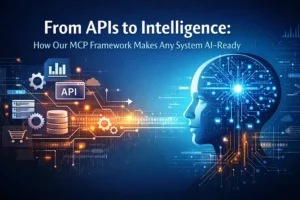
- Interoperability via APIs and Service Layers: The AI must integrate seamlessly through APIs, MOCA commands, or microservices that allow for safe interventions within existing logic.
- Simulation and Feedback Loops: Before any action is taken live, AI agents need a sandbox to test decisions and learn from outcomes.
At Smart IS, this is the direction we’re actively pursuing. Through our AI initiatives like the Smart Assistant and the Smart-IS Intelligence Engine, we are laying the groundwork for agentic frameworks in warehouse ecosystems.
The Smart Assistant is already enabling cross-platform visibility and natural language interaction across Blue Yonder WMS, ERP, CRM, and other enterprise tools. It functions as a conversational layer, turning natural language inputs into structured system actions, reducing the cognitive and operational friction for end users.
Complementing this, the Smart-IS Intelligence Engine embodies the architectural principles of agentic AI: it processes user inputs securely, leverages adaptive memory, and translates requests into precise system commands while capturing real-time analytics. Our Intelligence Engine architecture includes advanced logging, vector database capabilities, and secure function execution, all foundational elements for future agentic behavior.
While these solutions are not fully there yet, they incorporate the core principles of agentic design: autonomy, contextual memory, and proactive decision support. This positions us to evolve further, where these systems won’t just respond, they’ll plan, adapt, and optimize continuously.
In other words, we’re engineering the bridge to get there.
Conclusion: Preparing for the Next Era of Warehouse Intelligence
Warehouses have always been operational nerve centers, where precision, timing, and coordination define success. As operational complexity deepens, the industry faces a new challenge: the need for systems that don’t just process but think.
Agentic AI is not a replacement for the traditional WMS systems, but an evolution that complements them: driving proactive decisions, orchestrating across platforms, and reducing operational friction. Warehouses won’t transform overnight. But the architecture for intelligent, self-directed operations is already taking shape. Those who start integrating these capabilities today will be the ones best positioned to navigate the operational demands of tomorrow. At Smart IS, we’re part of this evolution.
If your warehouse operations are ready to move from static optimization to intelligent autonomy, let’s start the conversation. Contact us to discuss your operational challenges and see how our AI-driven solutions can create real-world impact.