
Skip to content

Contact us

    Talk to our Experts


    +1 920 303 0470
    info@smart-is.com 1302 S Main ST , Oshkosh , WI 54902-6518

    Benefits of Leveraging an Off-Shore Team

    American businesses have been outsourcing and offshoring tasks and processes for decades. However, what were once a set of disjointed teams, with ‘low level’, ‘tactical’ tasks and activities thrown over the fence to be completed by the offshore workforce, has now evolved into blended and collaborative teams, jointly working on ‘strategic’ projects with common goals. It is no longer a simple case of cost-management. Instead, it is about scalability, efficiency, and most importantly, access to the global talent pool with diverse experiences.

    With the general shortage of IT Professionals in the United States and a continuously increasing demand for IT systems across the business spectrum, more and more American based organizations are forming partnerships with offshore service providers.

    The offshore providers employ a complete spectrum of project roles, who are working side-by-side with their onshore counterparts. This work-style and a general adoption of agile methodologies in most IT teams, has made ‘effective communication’ and ‘good project governance’ a necessary component of setting up offshore teams.

    So, are all offshore providers equal? Can all offshore teams produce equal results? What differentiates the ‘good’ and the ‘not-so-good’ offshore teams? Even the best of teams will fail if they cannot appreciate and understand the underlying business case. More importantly, they will fail to develop a direct understanding of the use-cases and usability scenarios/challenges. Indeed, even many onsite project teams fail to deliver on-target results when they fail to engage with the end user, and do not address the core business issues.

    Therefore, it becomes even more critical for offshore teams to figure out a way to directly engage with the business processes and the end user. A good onshore team that is fully integrated with the offshore team, forming a full-service onsite/off-shore delivery model, makes up the secret ingredient of a valuable and sustainable offshore model.

    For the last five years, Oracular has been doing just that! Oracular has been working with our offshore team (Smart IS) to develop a full service onsite/off-shore model. Together, we have developed blended teams and standard operating procedures; with a focus on delivering on-target and on-budget, quality results. As a result, Oracular can offer our customers, a full-service, scalable team with a thorough understanding of US based businesses and business processes.

    Reducing Risk and Adding Value: Oracular’s onsite team consists of Project Managers, Business Analysts, Solution Architects, and all the key resources needed for a project to be successful. Our off-shore team consists of the same key resources — all of which work closely with their counterparts at the Oshkosh office to develop solutions that best fit our clients’ needs.

    The offshore delivery managers are not only trained in the US, but also have extensive US based work experience. Moreover, the US-based team members routinely travel to the offshore office to ensure that the offshore team fully understands and appreciates the specific needs of the US-based end-users. All Oracular projects are initialized onsite with onshore teams, ensuring a direct engagement with the project stakeholders. Similarly, all deployments and user hand-offs are completed with the onsite teams. This extra effort enables solid communication between teams, minimizing the risk of information loss, or misunderstood requirements. With team members from both offices working together, our clients get the innovative solutions, an on-target delivery, along with, minimum risks of delays caused by re-work.

    A full service off-shore set up allows for an ideal customer service experience for our clients. The Oracular experience does not end with project deployment; instead, the affordable cost structure, coupled with certified and scalable teams, allow for a 24 x 7 Support and Managed Services engagements. This enables our clients to improve user acceptance and satisfaction, as well as continue to scale the projects to their evolving business needs.

    Oracular’s on-site/off-shore full-service delivery approach is designed to offer quality, scalability, and a cost-effective post-production support model. With this approach, Oracular hopes to challenge the status-quo. Oracular thrives to establish a culture of collaboration and innovation; while delivering maximum performance to establish a joint value proposition between Oracular and our customers.
    Leave a Reply

    Your email address will not be published. Required fields are marked *

    Recent Stories

    View All
    Blog Feature Image
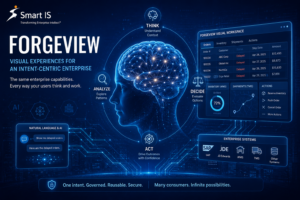
    ForgeViu: Visual Experiences for an Intent-Centric Enterprise
    Jun 12, 2026

    Technology has a habit of making us believe that every new breakthrough renders everything that came before it obsolete. When television became mainstream, many predicted the end of radio. When e-commerce emerged, some predicted the end of physical retail. When smartphones arrived, there were predictions that desktop computing would become irrelevant. Reality is usually more

    Read More
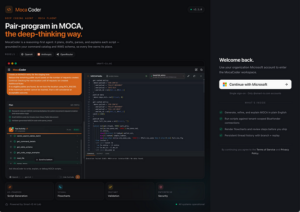
    Beyond the Crawl: A Coding Agent for Proprietary Programming Languages
    May 17, 2026

    General-purpose coding models perform well on languages that are well-represented on the public internet. They fail predictably on proprietary or domain-specific languages: hallucinated identifiers, wrong call shapes, and confident reproduction of deprecated patterns. MOCA, the scripting language inside Blue Yonder’s Warehouse Management System, is one of those failure cases, the entire ecosystem (grammar, command catalog,

    Read More
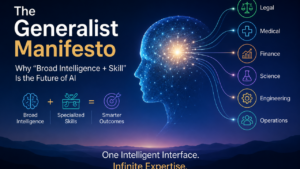
    The Generalist Manifesto: Why “Broad Intelligence + Skill” Is the Future of AI
    May 08, 2026

    For the past couple of years, we’ve seen a massive push toward Specialized LLMs. The argument seems intuitive: if you need legal expertise, use a legal model. If you need medical expertise, use a medical model. Why rely on a “general” model when you can have one trained specifically for the task at hand? In

    Read More
    Safety by Ignorance vs Safety by Understanding: What the Claude–DoD Debate Is Really About
    Apr 03, 2026

    There is a growing debate in AI governance that is often framed as a dispute over “safeguards,” “alignment,” or “responsible AI.” A recent flashpoint involves models developed by Anthropic (notably Claude) and the U.S. Department of Defense, but the disagreement is deeper than any single vendor or contract. At its core, the debate is not

    Read More
    From Chat to Capability: Operationalizing Enterprise AI Intents
    Apr 02, 2026

    In earlier posts, I argued two related ideas: This post builds directly on those ideas and takes the next logical step. If intent is the real abstraction — and if enterprises need repeatable, governed intelligence — then the obvious question is: Where does intent actually live, and how does it execute? The Missing Layer: Intent

    Read More
    Enterprise Cognitive Intelligence, Without the Complexity
    Feb 17, 2026

      In our previous post, we showed how our MCP framework removes the friction from exposing system capabilities to AI. MCP solves access. Cognition requires meaning. Because enterprises don’t think in systems.They think in business concepts. The Limits of System-Level Intelligence Most MCP servers today expose a single system — ERP, WMS, OMS, planning engines —

    Read More
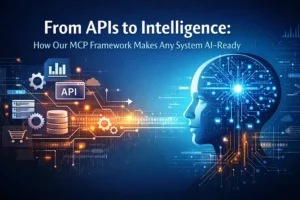
    From APIs to Intelligence: How Our MCP Framework Makes Any System AI-Ready
    Feb 17, 2026

    Everyone wants to “add AI” to their systems — but few succeed. Not because AI models aren’t powerful — they are. But because exposing enterprise systems to AI is still too hard. So for most teams, the friction is simply too high. A Useful Analogy: AI as a Researcher Think of AI as a researcher. At

    Read More
    F
    From System Silos to System Intelligence: The AI Shift Enterprises Cannot Afford to Ignore
    Dec 10, 2025

    Enterprises today operate in an environment where systems multiply, data sits fragmented, and real-time decisions depend on information scattered across platforms. The divide between organizations’ need for instant, secure, conversational access to enterprise intelligence and their reliance on siloed screens, complicated integrations, and manual reporting processes is increasing each year.   According to a survey report

    Read More
    Why Traditional Deployment Playbooks No Longer Keep Up with Modern Warehouses
    Oct 30, 2025

    Modern warehouses are evolving faster than the deployment practices that support them. What was once a predictable, linear, and manual deployment cycle has turned into a complex, high-stakes process that no longer fits the pace of operations. Traditional deployment playbooks were designed for slower systems with fewer moving parts. Today’s warehouses operate across multiple sites,

    Read More
    The Hidden Cost of Screen Development in Warehouse Reporting and the Solution
    The Hidden Cost of Screen Development in Warehouse Reporting and the Solution
    Oct 16, 2025

    Reporting sits at the core of every warehouse operation. It is the lens through which leaders make decisions, monitor performance, and anticipate challenges. Yet, behind the charts and dashboards lies a process that is often far more complex and costly than it should be. Screen development in warehouse reporting has become a silent drain on

    Read More