







Your brand is well developed, you’ve established a customer base, and you know that your customers like what you have to sell! But you know you still have room to grow, and you can offer your customers more! If your business is doing well at its physical location, then it can do well online. Selling online has become an essential offering for all businesses now, it is not enough just to have a website. You need to be able to sell virtually as well. As a business owner if you find yourselves and your team spread thin already, setting up an online store doesn’t have to be that complicated.
eCommerce platforms have existed for a long time to make online selling easier. But Covid-19 has truly shown us the value of these platforms, allowing many businesses to stay afloat during lockdown. Whether you are a B2B or B2C business, online selling is for you. Covid-19 has particular changed the relationship between B2B businesses and online selling by making selling directly to businesses and manufacturers simpler! But just because you aren’t online yet, doesn’t mean you aren’t doing well. Online selling can always expand your customer base, offer convenience to your customers and maintain a more long-term connection with your audience. That’s why you should consider if it is for your business too!
There are many eCommerce platforms out there, but 2 that are mentionable and take the lead in their industry, Magento and Shopify. To help you determine if these platforms will work for your business, we’ve done a comparison. The two platforms, both powerful, have different ways to offer you a similar end product, a site that sells!
Shopify –
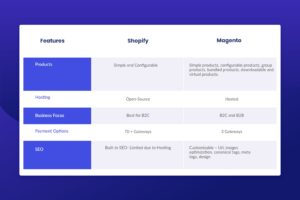
Shopify in a nutshell is a simpler software for a basic store setup and less expensive than Magento. This of course does mean that it does have some limitation when compared to Magento. It is geared towards businesses that want a quick site, with minimal coding, something more templated. The software does have a cost, but hosting is included in your costs. The cost can be anywhere from $400 to $3600, depending on the size of your shop and number of employees that will be working on the site (bsscommerce.com).
Shopify is setup so that you can create an online shop without the need of a developer, its templated options help to build a basic site that get you selling within as little as weeks. This is best for small businesses with single brands and a niche set of offerings geared towards selling B2C (bsscommerce.com). Though the features are more limited than Magento, it does not make it a lesser platform. It is all dependent on your needs as a business. There is no need to spend your budget on a complex software when your business needs don’t require it.
Magento 2 –
In this article we are focused on the latest version of Magento, Magento 2.4.2. As mentioned above, this platform has much more robust offering and can offer a lot more customization to build a complex online store. When it comes to cost, Magento can be more expensive based on your needs. It can cost anywhere from $200 to $4800 (bsscommerce.com). The software itself is open-source and free, but if you chose Magento Commerce or Cloud costs are added. Unlike Shopify’s themes, Magento 2 has themes that are more customizable to match your branding better.
With more options available, Magento requires that you have a medium level understanding of the software and coding. Magento is for companies that have multiple brands, technologies and a large set of offerings (bsscommerce.com). Magento 2 is unique in that if offers multi-store management on one interface. A complex store, that brings together products from different brands and warehouses, can setup systems to manage all their offerings on Magento 2 via this interface!
Magento Commerce is an offering for B2B businesses, with features like company accounts, B2B quotes, wholesale offerings and many more offerings. This allows B2B businesses to enhance their online store experience in a way they would not be able to on Shopify. Again, depending on the complexity of your site, Magento setup could take longer than Shopify, but would still be an efficient way to build multifaceted site.
Often we see opening an online store to be a painstakingly long and expensive process that is unachievable particularly for small to medium businesses. It isn’t. Creating a simple online store is an option, it can be built on and updated as your resources free up. Platforms like Magento and Shopify offer a range of packages, that fit various business needs. Taking the first step to kickstart your selling process has never been easier. Take the first step and enter the online selling game.
As business owners and managers, even these helpful platforms don’t fit into our busy schedules. For small/medium businesses, there may not be an in-house development team. For larger businesses, your team may already be occupied on billable tasks. Smart IS International offers a full service Marketing Agency, Smart Marketing Group, with web and eCommerce solution for your team. Taking your business objectives into consideration, our team of developers, UX/UI designer and content developers work together to create a simple and effective experience for you customers. Contact us for a consultation and see if we are the best fit for your company at info@smg-intl.com.
Source:
https://bsscommerce.com/blog/shopify-vs-magento-which-one-is-suitable-for-you/