







Skip to content

Contact us

    Talk to our Experts


    +1 920 303 0470
    info@smart-is.com 1302 S Main ST , Oshkosh , WI 54902-6518

    Modern Agile Trends

    The word “AGILE” is very common in the software and IT industry today. Let me shed some light on why we hear this in every software development success story.

    Definition of agile:

    “Agile is an iterative project management and software development approach that helps teams deliver value to their customers faster and without worry. Instead of betting everything on a ‘big bang launch, an agile team delivers work in small but consumable increments.”

    In the modern age, business is full of techniques, processes, methodologies, and tools that fall under the agile umbrella.

    Many consider these other promotions ballyhoo over agile, feeling that they move away from the simplicity that agile principles promote. Agile aims to maneuver to the next level, not by adding complexity, but by simplifying – focusing only on the following four principles.

    Modern agile

    What is Modern Agile?

    Modern Agile is much broader than an agile framework. It is a concept that takes into account many more areas. Modern Agile has no roles, responsibilities, or fixed frameworks that allow project teams more freedom to get things done.

    Over the past few years, technology companies, software houses, and tech entrepreneurs have thought that leaders and lean/agile practitioners have discovered easier, more resilient, and more effective ways to be agile. These fashionable approaches share the spotlight in producing exceptional results and cultivating an excellent culture.

    Modern agile methods are defined by four main principles:

    • Make People Awesome

    • Make safety a prerequisite

    • Experiment and learn quickly

    • Deliver value continuously

    World-famous technology companies like Google, Amazon, Airbnb, Etsy and more. They are modern examples of these four principles. However, you don’t have to be a company with a complete reputation to take advantage of the agile knowledge trends.

    Modern Agile is a community for people who want to discover better ways to achieve amazing results. It uses wisdom from many industries, is principles-based and framework-free.

    . Joshua Kerievsky, CEO, of Industrial Logic

    Make People Awesome

    When a product or service-based company starts a process, it must work directly or laterally in a direction that satisfies its stakeholders. In the process, he must also ensure that his developers/engineers and other involved team members are not exploited or suffer. The first principle of Modern Agile is also about the same.

    This principle suggests that businesses should accurately cover everyone, understand their pain points, find out their limitations and help them come (or feel) valuable and awesome.

    Make safety a prerequisite

    Safety is a basic human need and at the same time the key to being able to perform at a high level. This point emphasizes that safety is a prerequisite. This principle helps you protect people’s time, information, reputation, money, health and relationships.

    Experiment and learn fast

    You can’t make people awesome or make safety a prerequisite if you don’t learn. We learn quickly through frequent experimentation. We make our experiments “fail safe” so we are not afraid to do more experiments. When we get stuck or don’t learn enough, we take it as a sign that we need to learn more by doing more experiments.

    Deliver value continuously

    Anything that isn’t delivered doesn’t help anyone become more awesome or safer. In modern agility, we ask ourselves, “How could valuable work be delivered faster? Delivering value continuously requires us to break larger amounts of value into smaller pieces that can be safely delivered now, not later.

    Resources
    1. https://modernagile.org/
    2. https://www.infoq.com/articles/modern-agile-intro/
    3. https://techbeacon.com/app-dev-testing/modern-agile-heart-agile-new-focus-agile-development
    4. https://blog.crisp.se/2018/06/27/mikaelbrodd/modern-agile
    5. https://www.agilealliance.org/resources/videos/modern-agile/
    6. https://www.boye-co.com/blog/2018/10/29/modern-agile-means-doing-things-very-differently-than-ten-years-ago
    7. https://www.industriallogic.com/modern-agile-workshop/

    Leave a Reply

    Your email address will not be published. Required fields are marked *

    Recent Stories

    View All
    Nearshoring y la brecha en la ejecución del almacén en Latinoamérica  
    Aug 06, 2026

    El nearshoring está transformando las cadenas de suministro globales y posicionando a América Latina como uno de sus principales beneficiarios. A medida que fabricantes y retailers acercan la producción y la distribución a los mercados finales, la inversión en la región continúa acelerándose.  Los datos de nearshoring y cadena de suministro mencionados a lo largo de este blog provienen de investigaciones

    Read More
    Blog Feature Image
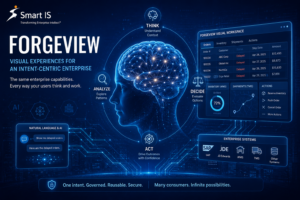
    ForgeViu: Visual Experiences for an Intent-Centric Enterprise
    Jun 12, 2026

    Technology has a habit of making us believe that every new breakthrough renders everything that came before it obsolete. When television became mainstream, many predicted the end of radio. When e-commerce emerged, some predicted the end of physical retail. When smartphones arrived, there were predictions that desktop computing would become irrelevant. Reality is usually more

    Read More
    Beyond the Crawl: A Coding Agent for Proprietary Programming Languages
    May 17, 2026

    General-purpose coding models perform well on languages that are well-represented on the public internet. They fail predictably on proprietary or domain-specific languages: hallucinated identifiers, wrong call shapes, and confident reproduction of deprecated patterns. MOCA, the scripting language inside Blue Yonder’s Warehouse Management System, is one of those failure cases, the entire ecosystem (grammar, command catalog,

    Read More
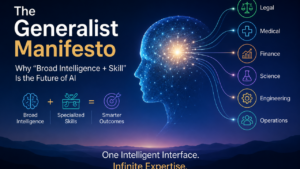
    The Generalist Manifesto: Why “Broad Intelligence + Skill” Is the Future of AI
    May 08, 2026

    For the past couple of years, we’ve seen a massive push toward Specialized LLMs. The argument seems intuitive: if you need legal expertise, use a legal model. If you need medical expertise, use a medical model. Why rely on a “general” model when you can have one trained specifically for the task at hand? In

    Read More
    Safety by Ignorance vs Safety by Understanding: What the Claude–DoD Debate Is Really About
    Apr 03, 2026

    There is a growing debate in AI governance that is often framed as a dispute over “safeguards,” “alignment,” or “responsible AI.” A recent flashpoint involves models developed by Anthropic (notably Claude) and the U.S. Department of Defense, but the disagreement is deeper than any single vendor or contract. At its core, the debate is not

    Read More
    From Chat to Capability: Operationalizing Enterprise AI Intents
    Apr 02, 2026

    In earlier posts, I argued two related ideas: This post builds directly on those ideas and takes the next logical step. If intent is the real abstraction — and if enterprises need repeatable, governed intelligence — then the obvious question is: Where does intent actually live, and how does it execute? The Missing Layer: Intent

    Read More
    Enterprise Cognitive Intelligence, Without the Complexity
    Feb 17, 2026

      In our previous post, we showed how our MCP framework removes the friction from exposing system capabilities to AI. MCP solves access. Cognition requires meaning. Because enterprises don’t think in systems.They think in business concepts. The Limits of System-Level Intelligence Most MCP servers today expose a single system — ERP, WMS, OMS, planning engines —

    Read More
    From APIs to Intelligence: How Our MCP Framework Makes Any System AI-Ready
    Feb 17, 2026

    Everyone wants to “add AI” to their systems — but few succeed. Not because AI models aren’t powerful — they are. But because exposing enterprise systems to AI is still too hard. So for most teams, the friction is simply too high. A Useful Analogy: AI as a Researcher Think of AI as a researcher. At

    Read More
    F
    From System Silos to System Intelligence: The AI Shift Enterprises Cannot Afford to Ignore
    Dec 10, 2025

    Enterprises today operate in an environment where systems multiply, data sits fragmented, and real-time decisions depend on information scattered across platforms. The divide between organizations’ need for instant, secure, conversational access to enterprise intelligence and their reliance on siloed screens, complicated integrations, and manual reporting processes is increasing each year.   According to a survey report

    Read More
    Why Traditional Deployment Playbooks No Longer Keep Up with Modern Warehouses
    Oct 30, 2025

    Modern warehouses are evolving faster than the deployment practices that support them. What was once a predictable, linear, and manual deployment cycle has turned into a complex, high-stakes process that no longer fits the pace of operations. Traditional deployment playbooks were designed for slower systems with fewer moving parts. Today’s warehouses operate across multiple sites,

    Read More