







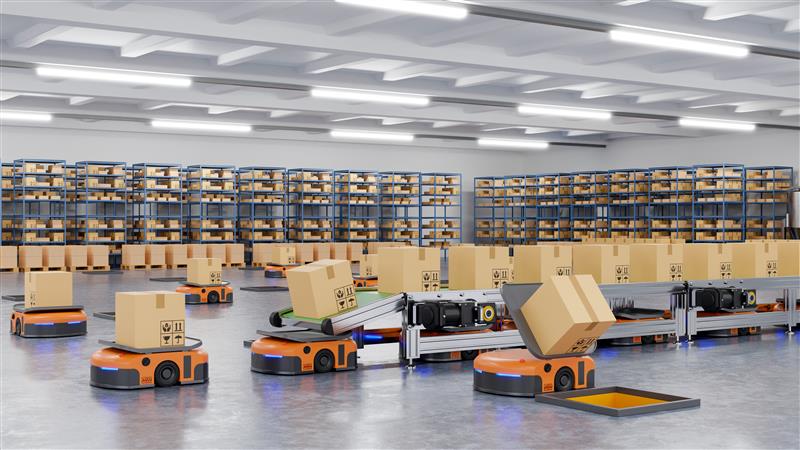
Since the emergence of AI in the early 2010s, different industries have experienced significant changes. The field of warehouse management is no exception and is undergoing a transformation driven by the rapid adoption of AI in warehouse management and warehouse automation technologies. It has been observed that the warehouses implementing automation technologies have experienced a 25% decrease in workplace injuries and a 35% boost in productivity.
With over 35 years of experience, Smart IS has been at the forefront of delivering innovative warehouse management solutions, helping some of the world’s leading organizations harness cutting-edge technologies to achieve operational excellence. In this blog post, we will explore AI’s transformative role in warehouse management and how automation, backed by cutting-edge technologies, is shaping the future of supply chain operations.
The Role of AI in Warehouse Management and Automation
The convergence of AI in warehouse management and warehouse automation fundamentally redefines how supply chains operate. Machine learning algorithms continuously refine processes, learning from historical data to enhance accuracy and decision-making. For instance, AI-powered inventory systems can dynamically allocate storage based on product demand, minimizing retrieval times and reducing operational costs.
Automation amplifies these capabilities, integrating seamlessly with AI-driven WMS solutions. Intelligent robotics, guided by AI models, ensure precise order picking and packing, while IoT-enabled sensors provide real-time visibility into inventory and equipment performance. According to McKinsey Digital, companies that utilize AI-powered forecasting in their supply chains see a substantial decrease in errors, with reductions of 30% to 50%. Together, AI and automation create self-sustaining warehouse ecosystems where decisions are data-driven, operations are error-free, and processes are optimized to meet the demands of complex supply chains.
Also Read: How Data Analytics Revolutionizes Warehouse Management
Future Trends in AI and Warehouse Automation
The next wave of advancements in AI in warehouse management and warehouse automation will redefine operational capabilities, making warehouses smarter, faster, and more adaptive. Approximately 42% of warehouses plan to invest further in artificial intelligence technologies in the near future, indicating a robust trend toward integrating AI into warehouse operations. Below are the key trends shaping the future:
Autonomous Warehouses
The vision of fully autonomous warehouses is becoming a reality, with AI and automation eliminating manual intervention in core processes. AI-driven robotics will handle tasks such as picking, packing, and sorting while real-time decision-making systems optimize workflows.
Predictive and Prescriptive Analytics
AI-powered analytics will evolve from predicting future demand to prescribing precise actions. For example, algorithms will not only forecast stock shortages but also suggest optimal replenishment strategies, factoring in supplier lead times, transit conditions, and cost optimization.
Advanced IoT Integration
The combination of IoT and AI will enable hyper-connected warehouses. IoT sensors will feed real-time data into AI systems, providing granular visibility into inventory levels, equipment health, and environmental conditions. This data will drive smarter automation and proactive maintenance.
Human-AI Collaboration
While automation will handle repetitive tasks, human workers will collaborate with AI systems to address complex or specialized operations. AI-driven assistants will empower workers with insights and capabilities, improving safety and efficiency.
Smart IS: Leading the Way in Warehouse Automation
With over three decades of experience in warehouse management, Smart IS understands the future of warehouse operations by integrating AI and automation into Blue Yonder WMS. Our focus is on providing sophisticated, high-performance solutions that optimize workflows and reduce manual dependencies by utilizing AI in Warehouse Management. We offer a range of powerful WMS tools, including AuTest, which automates the testing process to ensure system reliability, and Auto Waving, designed to automate wave planning for more efficient order fulfillment.
Additionally, our Warehouse Migrator simplifies the migration of configuration data, ensuring smooth transitions across environments. But this is just the beginning. Our extensive portfolio of AI and RPA-driven tools includes a variety of solutions tailored to meet the unique challenges of your warehouse environment, ensuring agility, accuracy, and scalability in every operation.
Conclusion
The future of warehouse management lies in integrating automation and AI in warehouse management. These technologies enhance operational efficiency, accuracy, and scalability while reducing costs and manual errors. Smart solutions like Auto Waving, AuTest, and Warehouse Migrator are already transforming how warehouses operate, overcoming challenges, and driving progress in automation.
Smart IS is leading the way in this transformation, offering tailored solutions for Blue Yonder WMS. We help businesses adopt AI and RPA seamlessly, ensuring they remain agile and future-ready in an increasingly digital world.





One thought on “The Future of Warehouse Management with AI and Automation ”
AI-driven slotting deserves more attention than it usually gets. It’s one of the more immediately ROI-positive applications in warehousing because reduced travel time shows up in pick rates fairly quickly after implementation. What often gets underestimated is how dependent the output is on upstream data quality: inconsistent SKU master data or gaps in historical pick records, and the slotting recommendations lose much of their value, which is really a case for getting the warehouse management system foundations right before layering AI on top. Good to see the human-robot collaboration section framed realistically rather than treating full automation as a near-term reality for most mid-market operations.
Ario