








In logistics, warehouses are the backbone of supply chains, and their efficiency directly impacts business success. However, traditional RF systems struggle to keep up with the demands of modern operations, burdened by outdated hardware, rigid workflows, and steep learning curves. Considering all these gaps that we at Smart IS observed, we devised an ultimate solution: Smart RF Plus. This groundbreaking solution redefines how warehouses operate by combining cutting-edge technology with an intuitive, user-focused approach.
Designed to enhance Blue Yonder WMS implementations, Smart RF Plus offers an advanced RF experience that is as adaptable as it is powerful. Running seamlessly on Android devices and integrating features like additional info display and device-level extensions eliminates many bottlenecks plaguing legacy systems. Let’s discuss the key features that make Smart RF Plus a game-changer, explore its role in solving traditional RF challenges, and discover why it stands out as the ultimate RF solution for modern warehouses.
Modernizing Warehouse Operations with Smart RF Plus
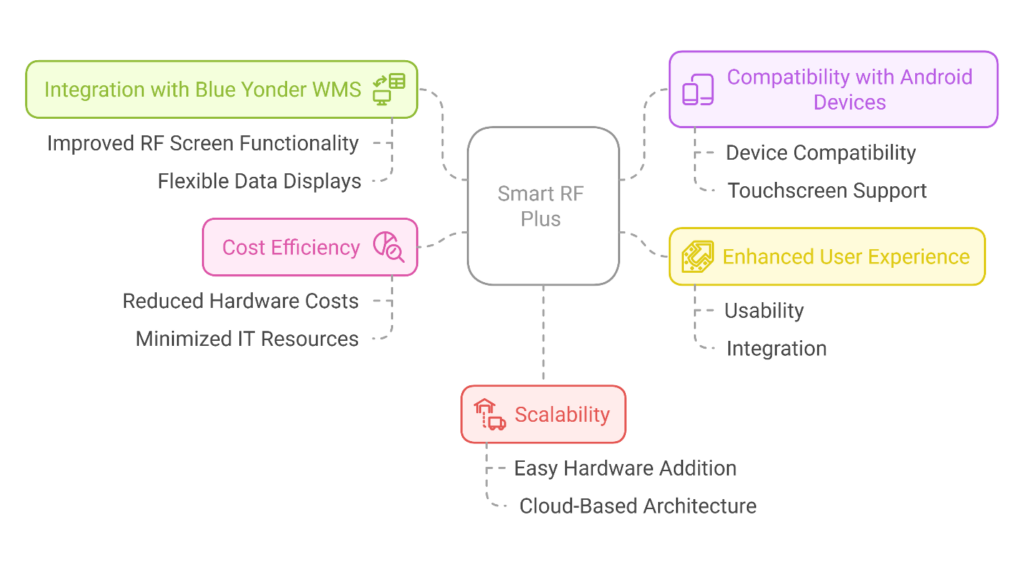
Traditional RF systems, while functional, have long been limited by a lack of flexibility to adapt to modern needs. As companies grow and evolve, their warehouse management systems need to scale and support new technologies – something that older RF solutions struggle to achieve. Smart RF Plus was created to bridge this gap. Built specifically for Blue Yonder WMS, it is one of the most widely adopted solutions in the logistics industry.
While Blue Yonder WMS excels in providing a comprehensive suite of tools for warehouse management, the user experience and the physical devices used on the warehouse floor often leave much to be desired. The challenge was clear: how could we enhance the WMS experience without requiring major overhauls or additional heavy investments?
That’s where Smart RF Plus comes in. It takes the strength of Blue Yonder WMS and transforms the way users interact with it. By providing an Android-based RF solution that works seamlessly with existing systems, Smart RF Plus eliminates the need for expensive proprietary devices and adds a layer of flexibility that traditional solutions simply can’t match. Ultimately, Smart RF Plus was created to meet the needs of modern warehouses, offering an easy-to-deploy, cost-effective solution that enhances the existing BY WMS infrastructure.
Also Read: Why Developers Love the MOCA Client: Top Features and Benefits
The Features That Redefine RF Functionality
Smart RF Plus is built to push the boundaries of what traditional RF solutions can offer. Focusing on usability, flexibility, and integration transforms the way warehouse teams interact with Blue Yonder WMS, making daily operations smoother and more efficient.
Enhanced RF Screen Functionality
The core of Smart RF Plus is its ability to enhance the traditional RF screen experience. By converting function keys into easily accessible on-screen buttons, the app improves user interaction, creating a more intuitive interface. This design not only boosts efficiency but also minimizes the learning curve for new users.
Device Compatibility and Extensibility
Smart RF Plus offers seamless compatibility with a wide range of Android devices, from existing android RF guns and standard mobile devices to advanced scanners and IoT-enabled devices. This compatibility means that warehouses can use their existing Android-based hardware or even personal devices, cutting down on the need for expensive proprietary equipment.
Touchscreen Support
As touch devices have become ubiquitous, Smart RF Plus incorporates touchscreen functionality, allowing users to navigate through the system using gestures. This modern interface option streamlines tasks, particularly when working with large amounts of data or complex workflows. Touch gestures, such as swipe-right for accessing function keys, make the app feel natural and easy to use, even for employees who may not be as tech-savvy.
Flexible and Customizable Data Displays
Smart RF Plus provides warehouses with the ability to customize data displays without the need for extensive coding or developer intervention. This allows users to add new fields, integrate multimedia objects (such as images), and adjust their RF screens to meet evolving needs—all in real-time.
Simplified Device Integration and System Deployment
Setting up new devices or expanding a warehouse’s RF network is often a time-consuming and complex task. With Smart RF Plus, device integration is quick and straightforward. The app streamlines the onboarding process, enabling new devices to be added with minimal setup, reducing deployment time and ensuring smooth transitions when scaling operations.
Enterprise-Grade Architecture
Designed with scalability in mind, Smart RF Plus is optimized for enterprise deployment, ensuring it can support both small and large warehouse operations. Its lightweight architecture allows for rapid implementation across multiple locations without significant disruption to ongoing operations.
Auto Terminal Fetching & Auto Stuffing
The auto terminal fetching feature automatically retrieves the terminal ID, eliminating the need for manual data entry and reducing login time. Additionally, the auto-stuffing feature streamlines data input, further cutting down on the time spent on repetitive tasks and improving overall system efficiency.
Cost Efficiency and Scalability
Smart RF Plus is designed to deliver both immediate cost savings and long-term scalability for warehouses. As we explained earlier running on any Android device, it eliminates the need for expensive proprietary hardware, reducing capital expenditures and allowing businesses to leverage existing devices. This cost-effective solution also simplifies integration with Blue Yonder WMS, minimizing IT resources and reducing ongoing support costs.
In terms of scalability, Smart RF Plus easily adapts to growing operations. The app’s compatibility with a wide range of Android devices and its simple device integration makes it easy to add new hardware as needed without additional costs. Its cloud-based architecture supports seamless deployment across multiple locations, ensuring consistent performance as the warehouse network expands. By combining cost savings with scalability, Smart RF Plus enables warehouses to grow efficiently while maintaining flexibility and minimizing upfront investments.
Conclusion
Smart RF Plus from Smart IS is one of the finest solutions from our Blue Yonder WMS accelerators suite. Eliminating the need for expensive proprietary hardware and integrating seamlessly with Blue Yonder WMS empowers businesses to improve efficiency, reduce operational costs, and scale effortlessly as their needs evolve. It’s intuitive design and advanced features like auto terminal fetching ensure a smoother, more productive workflow for modern warehouses.
Request an RF Demo today and discover how Smart RF Plus can elevate your system. Contact Us for more information on implementing Smart RF Plus and optimizing your warehouse.