






Executive Summary
Artificial intelligence is rapidly becoming essential infrastructure for modern economies. Just as electricity powered the industrial age and the internet powered the information age, artificial intelligence is expected to power the next generation of economic growth, scientific discovery, healthcare, manufacturing, education, agriculture, and government services. AI data centers are the physical infrastructure that make this possible.
As communities across the United States evaluate proposals for AI data centers, many legitimate questions have emerged regarding water consumption, electricity demand, employment, taxation, environmental impact, and long-term community benefit. Much of the current public discussion, however, evaluates these facilities using assumptions developed for traditional manufacturing plants.
This paper argues that this comparison is increasingly inaccurate.
AI data centers are more appropriately evaluated as critical infrastructure—similar to power plants, electrical substations, water treatment facilities, and telecommunications networks—rather than as conventional factories. Their primary purpose is not to manufacture products within a building, but to transform electrical energy into computational capacity that enables economic activity far beyond the boundaries of the facility itself.
Accordingly, traditional measures such as jobs per acre or employees per square foot provide an incomplete picture of their value. Communities should instead evaluate AI infrastructure using the same principles applied to other critical infrastructure:
- Does it strengthen the region’s long-term economic competitiveness?
- Does it expand the local tax base?
- Does it improve supporting infrastructure such as electrical transmission and communications?
- Does it attract additional investment and complementary industries?
- Does it provide stable, long-term fiscal benefits to the community?
The paper also examines three of the most common concerns surrounding AI data centers.
Water. Modern cooling technologies are rapidly reducing dependence on traditional evaporative cooling. Direct liquid cooling, closed-loop systems, and processor-level thermal management are changing the relationship between computational growth and water consumption.
Electricity. AI facilities unquestionably require enormous amounts of power. However, electricity is also their largest operating expense, creating powerful economic incentives to invest in efficiency, renewable generation, advanced cooling, long-term power partnerships, and next-generation energy technologies.
Employment. While modern AI data centers employ fewer people than traditional manufacturing facilities of similar size, they should not be judged by factory metrics. Like power plants, airports, electrical substations, and telecommunications infrastructure, their value lies in enabling substantially larger economic ecosystems while generating significant property tax revenue, infrastructure investment, and highly skilled technical employment.
Rather than advocating for or against any specific development proposal, this paper seeks to provide local governments, policymakers, economic development officials, and community leaders with a framework for evaluating AI infrastructure based upon its long-term strategic role rather than historical assumptions.
The central conclusion is straightforward:
The question is not whether communities should compare AI data centers to factories. The better question is whether they should instead evaluate them as the power plants of the digital economy.
Every major technological revolution has required new forms of infrastructure.
The Industrial Revolution required railroads and power plants.
The Information Age required fiber optics and the Internet.
The AI Revolution requires computational infrastructure.
The question facing communities is not whether this infrastructure will exist, but where—and under what policies— it will be built.
— Saad Ahmad
AI Data Centers: The Power Plants of the Future
Rethinking Water, Energy, and Economic Value in Modern Infrastructure
Saad Ahmad
Abstract:
Artificial intelligence is creating unprecedented demand for hyperscale data centers, yet public debate often evaluates these facilities using assumptions inherited from traditional manufacturing. This paper argues that AI data centers are more appropriately understood as critical infrastructure—analogous to power plants rather than factories—and examines how that perspective changes discussions of water use, electricity demand, and community economic value.
- Executive Summary
- Introduction: Every Technology Revolution Requires New Infrastructure
- Managing Heat, Not Consuming Water
- Building the Grid of the Future
- Myth #2: “AI Data Centers Will Overwhelm the Electrical Grid”
- Electricity Is to AI What Fuel Is to a Power Plant
- Controlling Critical Inputs Is a Proven Business Strategy
- Reliability Is More Important Than Price
- From Electricity Consumers to Energy Partners
- Building the Grid of Tomorrow
- Looking Forward
- Key Takeaways
- Measuring the Right Thing
- Myth #3: “Data Centers Don’t Create Enough Jobs to Benefit the Community”
- The Twenty-First Century Economy Creates More Value with Fewer Workers
- The Better Question: What Total Value Does the Facility Create?
- AI Data Centers Are Better Compared with Power Plants Than Factories
- Employment in Context
- Direct Fiscal and Infrastructure Benefits
- Lower Population Growth Can Also Be a Fiscal Advantage
- Building an AI Infrastructure Ecosystem
- Beyond Taxes: Community Partnerships
- Cleaner Industry Has Value
- Looking Forward
- Key Takeaways
- References
Introduction: Every Technology Revolution Requires New Infrastructure
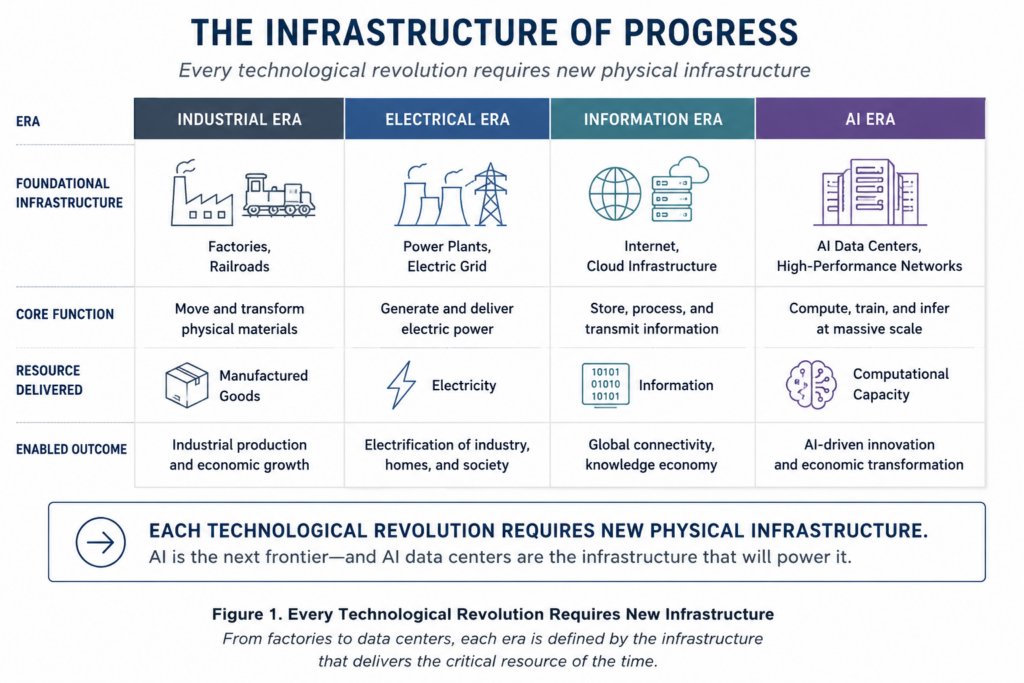
Every major technological transformation in human history has depended upon new forms of physical infrastructure.
The Industrial Revolution was enabled by factories, railroads, ports, and supply chains that allowed goods to be produced and distributed at unprecedented scale. The electrical age required power plants, transmission networks, and distribution systems that delivered reliable electricity to homes, businesses, and industries. The information age was made possible by telecommunications networks, data centers, and cloud computing platforms that connected the world and transformed how information could be created, shared, and consumed.
Today, the world is entering another technological transformation.
Artificial intelligence is rapidly becoming a foundational capability that will influence nearly every sector of society—from manufacturing and healthcare to transportation, education, finance, and scientific research.1
Like every technological revolution before it, however, AI requires physical infrastructure.
Behind every AI application are highly specialized computing systems requiring advanced processors, reliable electricity, sophisticated cooling, high-speed communications, and purpose-built facilities. These AI data centers are becoming the physical infrastructure that enables organizations to access computational capacity much as businesses and consumers access electricity from the electrical grid.2
AI itself is not a separate economy. It is becoming a foundational capability embedded throughout the broader economy, much as electricity, transportation, and telecommunications became indispensable inputs to modern society. The organizations that benefit from AI will span virtually every industry, just as nearly every modern business depends upon electricity and internet connectivity today.
As communities across the world consider proposals for new AI infrastructure, they are asking legitimate questions.
- How much water will these facilities consume?
- How will they affect local and regional electrical systems?
- Will they generate sufficient economic value to justify the land and infrastructure they require?
These are reasonable questions. Large infrastructure projects should always be evaluated carefully, and communities deserve transparent discussions regarding both their costs and their benefits.
The challenge is that AI data centers are frequently evaluated using comparisons that no longer fit the role they are beginning to play.
Although they may resemble large industrial buildings, their purpose is fundamentally different from that of traditional manufacturing facilities. They do not primarily produce physical goods or seek to maximize employment density. Their purpose is to provide computational capacity that increasingly supports every sector of the economy.
This paper argues that AI data centers should be evaluated as critical infrastructure rather than as traditional industrial facilities.
Specifically, it proposes that the most appropriate comparison is not the factories of the past, but the power plants that enabled the modern economy.
Viewed through that lens, many of today’s discussions surrounding water consumption, electricity demand, and economic value take on a very different perspective.
Unless otherwise stated, this paper focuses primarily on hyperscale AI data centers because they are the facilities most often discussed in public policy debates concerning water, electricity, and community economic impact.
Managing Heat, Not Consuming Water
Myth #1: “AI Data Centers Consume Too Much Water”
One of the most common concerns surrounding AI data centers is their water consumption. Headlines often report billions of gallons of annual water use, creating the impression that water is an indispensable resource for artificial intelligence and that continued growth in AI will inevitably require ever-increasing quantities of water.
The concern is understandable. Water is one of our most valuable natural resources, and communities have every right to ask how major infrastructure projects will affect local supplies.
The engineering challenge, however, is frequently misunderstood.
The Real Engineering Challenge Is Heat
Every processor inside a data center consumes electricity while performing computations. From the perspective of physics, virtually every watt of electricity ultimately becomes heat.
Whether a processor is serving a web page, processing financial transactions, or training a large language model, the electrical energy it consumes must eventually be removed as heat to maintain reliable operation.
This simple physical reality defines every aspect of data center cooling.
The objective is not to consume water.
The objective is to remove heat.
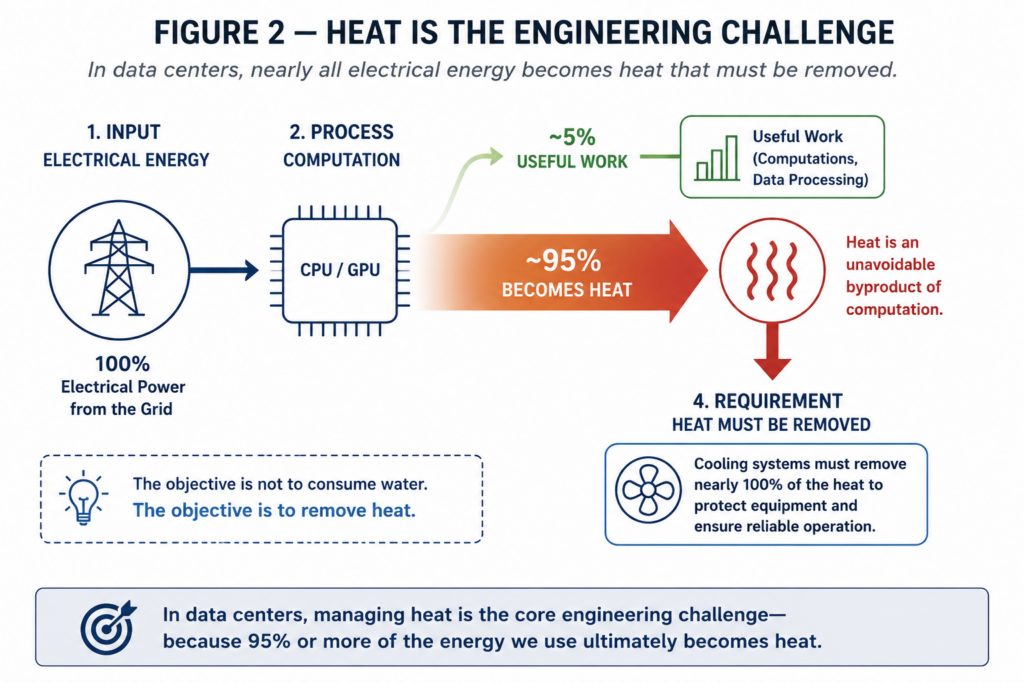
Understanding this distinction fundamentally changes the discussion. Water is only one of several engineering approaches available to transfer heat away from computing equipment. How much water a data center uses depends largely on the cooling technologies selected, local environmental conditions, and economic trade-offs—not on AI itself.
Why Water Became a Popular Cooling Solution
Historically, evaporative cooling became one of the most widely adopted approaches because it provided an attractive balance between energy efficiency and operating cost.3
Electricity is one of the largest recurring operating expenses for any hyperscale data center. Cooling systems based entirely on refrigeration require substantial electrical power, reducing the electricity available for computation while increasing operating costs.
Evaporative cooling towers reduce that electrical demand by allowing a small portion of circulating water to evaporate. The phase change from liquid to vapor removes significant quantities of heat with comparatively little additional energy consumption.
For many years, this represented the most economical engineering solution in suitable climates.
The important point is often overlooked:
Historically, data centers consumed water not because water was the objective, but because modest water consumption reduced electricity consumption.
Water was part of an engineering optimization—not the engineering objective.
Modern Cooling Technologies
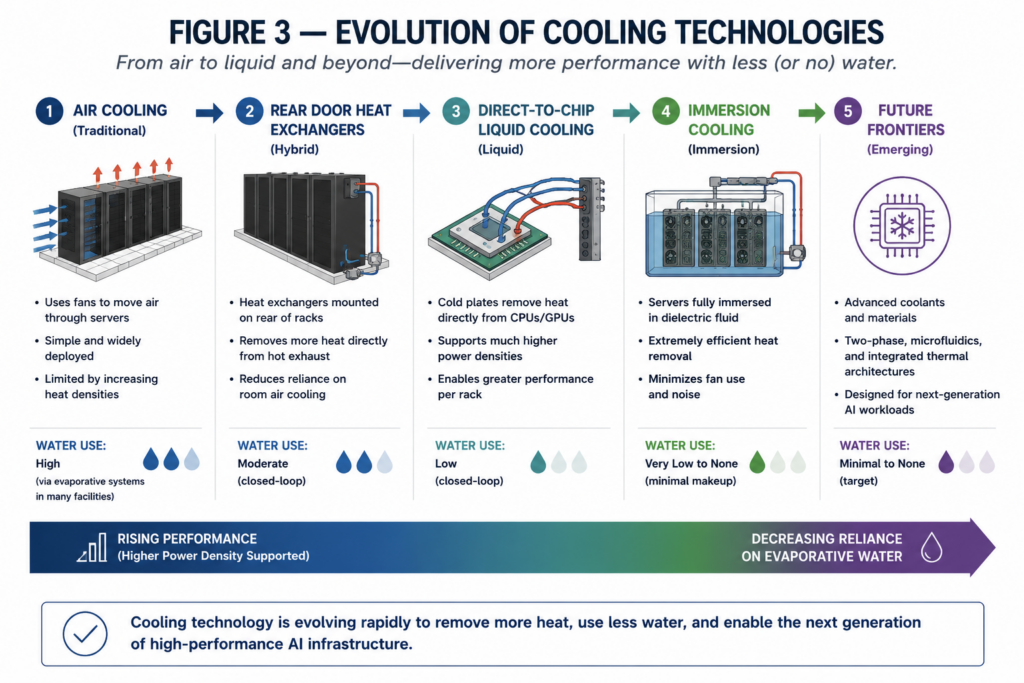
Cooling technologies continue evolving as computing requirements become more demanding. Today’s data centers employ several different approaches, each designed to balance reliability, efficiency, cost, and environmental impact.
Air Cooling
Traditional enterprise data centers rely primarily on conditioned air. Computer room air handlers circulate cooled air through server racks while warmer exhaust air is collected, cooled, and recirculated.
Air cooling remains effective for many conventional computing workloads because it is relatively simple, well understood, and requires little or no direct water consumption.
However, air is a relatively poor conductor of heat. As AI processors continue increasing in power density, moving sufficient heat using air alone becomes increasingly challenging.
Evaporative Cooling
Many hyperscale facilities supplement air cooling with evaporative cooling systems.
Cooling towers remove heat by allowing a small amount of water to evaporate, carrying thermal energy away from the cooling system. This approach significantly reduces electrical consumption compared with refrigeration-based cooling but does require periodic water replenishment.
For many years, evaporative cooling represented the optimal balance between energy efficiency and water consumption, particularly in climates where water was relatively abundant.
Direct Liquid Cooling
Artificial intelligence is now changing the economics of cooling.
Modern AI processors generate substantially more heat than traditional servers. Rather than attempting to remove this heat using large volumes of moving air, direct liquid cooling delivers coolant through sealed cold plates attached directly to the processors generating the greatest thermal load.4
Because liquids transfer heat far more efficiently than air, these systems can support significantly higher computing densities while reducing the energy required for cooling.
Equally important, the coolant circulates continuously through a closed-loop system. Unlike evaporative cooling towers, the cooling liquid itself is generally reused rather than consumed during normal operation.
As AI computing continues to increase in density, direct liquid cooling is rapidly becoming the preferred architecture for many hyperscale AI deployments.5
Cooling Is an Engineering Optimization Problem
No single cooling technology is ideal for every location.
Engineers must balance multiple considerations simultaneously, including:
- Reliable operation.
- Energy efficiency.
- Water availability.
- Local climate.
- Capital investment.
- Operating cost.
- Environmental sustainability.
The optimal solution for a facility in Arizona may differ significantly from one in Wisconsin, Northern Europe, or Southeast Asia. Climate, electricity prices, water resources, and regulatory requirements all influence the final system design.
The industry’s strength lies in this flexibility. Data center cooling is not a fixed technology but an engineering discipline that continuously adapts as processors become more powerful and new cooling techniques mature.
Looking Forward
Public discussion often assumes that increasing AI adoption will inevitably require proportionally greater water consumption.6
The evidence suggests a more nuanced future.
As processor power densities continue increasing, cooling technologies are evolving from traditional air-based systems toward direct liquid cooling and other advanced thermal management techniques that can reduce dependence on evaporative water consumption while supporting dramatically greater computational performance. This transition is being driven by the rapid increase in processor heat output: whereas many traditional server processors dissipate only a few hundred watts, modern AI accelerators can dissipate roughly 700 to well over 1,000 watts each, making efficient heat removal an increasingly important engineering challenge rather than simply an operational consideration. As a result, future advances in AI infrastructure will increasingly depend not only on faster processors but also on innovations in thermal engineering that enable those processors to operate reliably and efficiently.7
The future of AI infrastructure will not be defined by how much water it consumes.
It will be defined by how effectively engineers continue improving the efficiency with which heat is removed from increasingly powerful computing systems.
Just as power plants have evolved over decades to generate electricity more efficiently while reducing their environmental footprint, AI data centers are undergoing rapid innovation in cooling technologies. Their objective remains the same: deliver ever-greater computational capability while using resources as responsibly and efficiently as possible.
Key Takeaways
- The primary engineering challenge for AI data centers is removing heat, not consuming water.
- Water is one of several cooling technologies available and historically became popular because it reduced electricity consumption rather than because it was inherently required.
- Modern cooling technologies—including direct-to-chip liquid cooling and other advanced thermal management systems—are steadily reducing the historical relationship between computational growth and water consumption.
- Cooling system design is an engineering optimization that balances reliability, energy efficiency, water availability, climate, operating cost, and environmental sustainability.
- The future of AI infrastructure will be shaped not by increasing water consumption, but by continued innovation in heat management technologies that enable greater computational capacity while using resources more efficiently.
Building the Grid of the Future
Myth #2: “AI Data Centers Will Overwhelm the Electrical Grid”
As artificial intelligence continues expanding, perhaps no concern has received more public attention than electricity consumption. Reports of hyperscale AI data centers requiring hundreds of megawatts of power have understandably led many communities to ask whether this new generation of infrastructure will overwhelm existing electrical systems.
The concern is understandable.
Artificial intelligence is among the fastest-growing sources of electricity demand in decades. Supporting that growth will require significant investments in generation, transmission, and distribution infrastructure.
The question, however, is not whether AI data centers consume electricity.
They do.
The more important question is whether this growing demand should be viewed simply as a burden—or as a catalyst for building the next generation of electrical infrastructure.
Electricity Is to AI What Fuel Is to a Power Plant
One of the most useful ways to understand modern AI infrastructure is to compare it with a traditional power plant.
A power plant consumes fuel—whether coal, natural gas, uranium, or hydroelectric potential energy—to produce electricity for the electrical grid.
An AI data center performs a remarkably similar function.
Rather than consuming fuel, it consumes electricity. Rather than producing electricity, it produces computational capacity that is delivered through high-speed communications networks to businesses, governments, researchers, healthcare providers, manufacturers, and consumers around the world.
The comparison is striking.
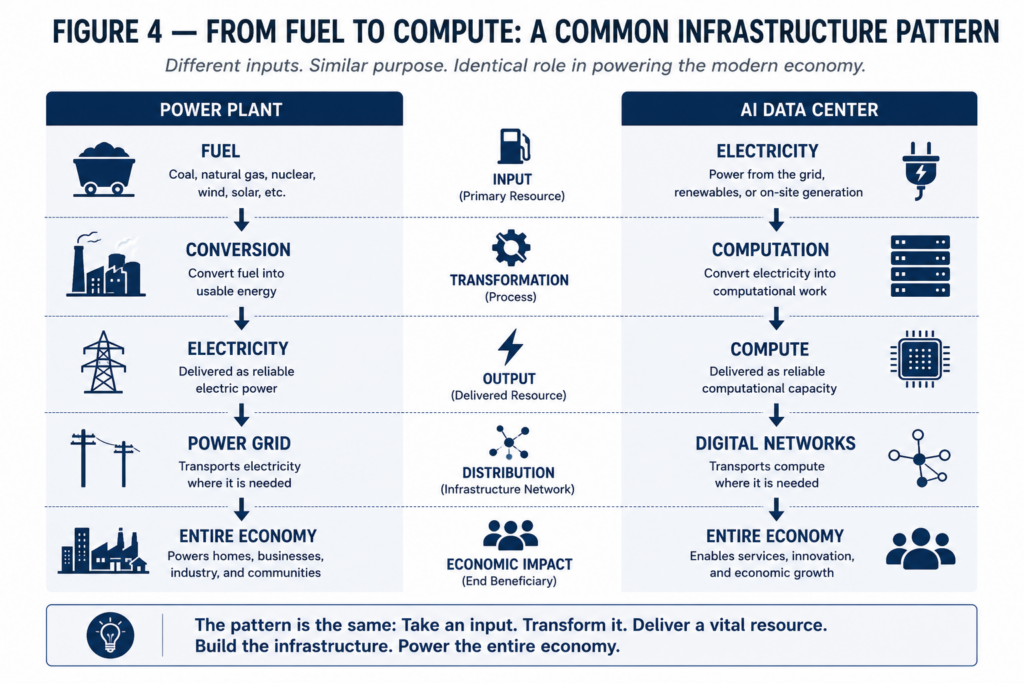
Viewed from this perspective, electricity is not simply another operating expense for AI infrastructure.
It is the essential raw material from which computational capability is produced.
Controlling Critical Inputs Is a Proven Business Strategy
Throughout industrial history, companies whose success depended upon a single critical input have repeatedly invested in securing long-term access to that input rather than remaining passive purchasers in open markets.8
Electric utilities have long secured dependable fuel supplies through long-term coal contracts, natural gas transportation agreements, uranium procurement strategies, and in many cases vertically integrated operations spanning generation, transmission, and distribution. Their objective has never been merely to purchase fuel at the lowest possible price. Their objective has been to ensure reliable electricity production for decades.9
The same pattern appears across many industries. Airlines hedge fuel costs because aviation depends upon predictable access to jet fuel. Aluminum smelters are often located where abundant electricity is available because electrical power dominates production costs. Manufacturers build near ports, railroads, and transportation corridors to secure efficient access to critical supply chains.
Hyperscale AI operators are now following the same economic principles.10
Electricity has become the essential input required to produce computational capacity. As AI infrastructure continues expanding, operators are increasingly seeking greater control over the availability, reliability, and long-term economics of that input.11 12
This should not be viewed as a departure from established business practice.
It is precisely how capital-intensive industries have responded throughout modern economic history.
Reliability Is More Important Than Price
For most businesses, electricity is simply another operating expense.
For hyperscale AI data centers, uninterrupted electricity is fundamental to the services they provide.
Modern AI infrastructure operates continuously, supporting financial systems, healthcare organizations, manufacturers, researchers, governments, and millions of users around the world. Even brief interruptions can disrupt critical operations and result in significant financial consequences.
Consequently, reliability frequently becomes more important than minimizing the lowest possible electricity price.
This explains why hyperscale operators increasingly invest beyond the boundaries of their own facilities.
Their objective is not merely to purchase electricity.
Their objective is to ensure that reliable electricity will continue to be available as computational demand grows.
From Electricity Consumers to Energy Partners
This changing economic reality is reshaping the relationship between hyperscale operators and electric utilities.
Rather than acting solely as customers, many operators are becoming long-term partners in expanding electrical infrastructure.
Long-term power purchase agreements provide financial certainty that encourages construction of new generating capacity. Battery energy storage systems improve resilience while helping balance fluctuations in electricity supply and demand. Investments in substations and transmission upgrades accelerate the infrastructure required to serve growing computational demand.
Many companies are also exploring or investing in advanced geothermal energy, small modular nuclear reactors, and other reliable low-carbon generation technologies capable of supporting continuously operating AI infrastructure.
These investments are not driven by public relations.
They are driven by economics.
When one resource becomes the most important input to a business, history demonstrates that companies invest aggressively in securing it.
Building the Grid of Tomorrow
It is therefore misleading to view AI data centers only as consumers of electricity.
Large, financially stable customers create powerful incentives for utilities, independent power producers, and infrastructure investors to expand generating capacity, modernize transmission networks, and strengthen electrical systems.
The infrastructure constructed to support hyperscale AI campuses frequently benefits far more than the data center itself. New substations, upgraded transmission lines, additional generating capacity, and improved grid resilience strengthen the electrical system serving the broader region.
In this sense, AI infrastructure can become a catalyst for investments that might otherwise have taken many more years to materialize.
Looking Forward
Every major technological revolution has required new forms of infrastructure.
The widespread adoption of electricity required generating stations, transmission lines, and regional electrical grids. Those investments did not occur because electricity demand was viewed as a problem. They occurred because society recognized electricity as the foundation upon which future economic growth would depend.
Artificial intelligence represents a similar transition.
Just as power plants transform fuel into electricity, AI data centers transform electricity into computational capacity. Both facilities convert one essential resource into another upon which the broader economy depends.
The question, therefore, is not whether AI data centers require electricity.
The question is how society can build the electrical infrastructure needed to support the next generation of computational infrastructure.13
Key Takeaways
- Electricity is not merely an operating expense for AI data centers; it is the essential input from which computational capacity is produced.
- The relationship between power plants and fuel provides a useful analogy for understanding the relationship between AI data centers and electricity.
- Throughout history, capital-intensive industries have secured greater control over their most important production inputs through long-term investments and strategic partnerships.
- Hyperscale AI operators are increasingly following the same pattern by investing in long-term power purchase agreements, energy storage, transmission infrastructure, and emerging generation technologies.
- Rather than viewing AI solely as a source of additional electricity demand, policymakers should also recognize its potential to accelerate investment in stronger, more resilient electrical infrastructure.
Measuring the Right Thing
Myth #3: “Data Centers Don’t Create Enough Jobs to Benefit the Community”
Perhaps the most persistent criticism of hyperscale AI data centers is that they create too few permanent jobs to justify the land they occupy. A modern AI campus may represent an investment measured in billions of dollars while employing only a few hundred permanent workers. Compared to traditional manufacturing facilities or large distribution centers, this appears to many communities to be a disappointing return for hundreds of acres of industrial land.
The concern is understandable.
Local governments are responsible for making decisions that will shape their communities for generations. They must balance economic development with responsible land use, infrastructure planning, fiscal sustainability, and the long-term interests of their residents. When a community is asked to host nationally significant infrastructure, it is entirely appropriate to ask a simple question:
“What does our community receive in return?”
That question deserves a thoughtful answer.
The answer, however, depends on measuring the right thing.
The Twenty-First Century Economy Creates More Value with Fewer Workers
For much of the twentieth century, economic development was closely associated with employment. Large factories employed thousands of workers who purchased homes, supported local businesses, paid taxes, and contributed to the economic vitality of their communities. Measuring industrial development by the number of jobs created was therefore a reasonable and practical metric.14
Today’s economy increasingly operates differently.
Automation, robotics, advanced manufacturing, artificial intelligence, and highly specialized equipment have dramatically increased productivity while reducing the number of workers required to produce the same—or substantially greater—economic output.
Modern semiconductor fabrication plants, automated distribution centers, pharmaceutical facilities, container ports, and electrical generating stations all employ far fewer people than similarly sized industrial facilities built several decades ago.
This is not evidence of declining economic value.
It is evidence of increasing productivity.
The same transformation is occurring within AI infrastructure.
Like many forms of twenty-first century critical infrastructure, hyperscale AI data centers generate extraordinary economic value through capital investment, specialized equipment, engineering, automation, and technological capability rather than through large labor forces.
Evaluating these facilities using employment expectations inherited from the industrial age therefore risks measuring the wrong outcome.
The Better Question: What Total Value Does the Facility Create?
Employment remains an important measure of economic impact, but it is only one measure.
Communities also benefit from long-term tax revenue, infrastructure investment, private capital expenditure, highly skilled employment, regional business development, educational partnerships, and the strategic importance of hosting nationally significant infrastructure.
The more meaningful question therefore becomes:
Does this facility create sufficient long-term value to justify the land and infrastructure it requires?
Viewed through that lens, comparing AI data centers with traditional factories becomes increasingly difficult to justify.
A far more appropriate comparison exists.
AI Data Centers Are Better Compared with Power Plants Than Factories
Throughout this paper, AI data centers have been examined as infrastructure rather than manufacturing.
This distinction becomes particularly important when considering economic value.
Power plants are rarely evaluated according to the number of employees working within their fences. Their purpose is not to maximize employment density. Their purpose is to convert one essential resource into another that enables the broader economy.
As discussed in the previous chapter, a traditional generating station converts fuel into electricity, while an AI data center converts electricity into computational capacity. Both transform a critical input into an essential resource consumed far beyond the local community.
Power plants are valuable not because nearby communities consume all of the electricity they generate, but because they provide generating capacity that strengthens the electrical grid serving a much broader economy.
Likewise, AI data centers are valuable not because nearby businesses consume all of the computational capacity they produce, but because they provide computational capacity that increasingly supports every sector of the economy.
Once viewed through this lens, the question is no longer how many people work inside the facility, but how much long-term value that facility creates for the broader economy and the community that hosts it.
This distinction fundamentally changes how economic value should be measured.
Employment in Context
A modern hyperscale AI data center typically employs approximately 200 to 400 permanent professionals, including operations engineers, network engineers, electrical engineers, mechanical engineers, critical facilities technicians, cybersecurity specialists, and management personnel.
These are not entry-level positions. They represent highly skilled technical careers responsible for operating some of the most sophisticated infrastructure ever constructed.
By comparison, a large two-reactor nuclear generating station commonly employs approximately 800 to 1,500 permanent workers,15 while many hydroelectric generating facilities operate with only 50 to 300 permanent employees, despite often occupying substantially larger land areas when reservoirs and supporting infrastructure are included.
The comparison is revealing.
Society has never judged nuclear power plants or hydroelectric dams primarily by the number of employees per acre. Their value comes from the essential service they provide to the broader economy.
The same principle increasingly applies to AI infrastructure.
This does not diminish the importance of employment. High-quality jobs remain an important community benefit, and hyperscale AI data centers create positions that are generally among the highest-paying technical occupations within many regions.
Rather, it suggests that employment should be viewed as one component of a much broader assessment of community value.
The question is therefore not whether AI data centers employ as many people as twentieth-century factories; but if they generate sufficient long-term value to justify their presence within a community.
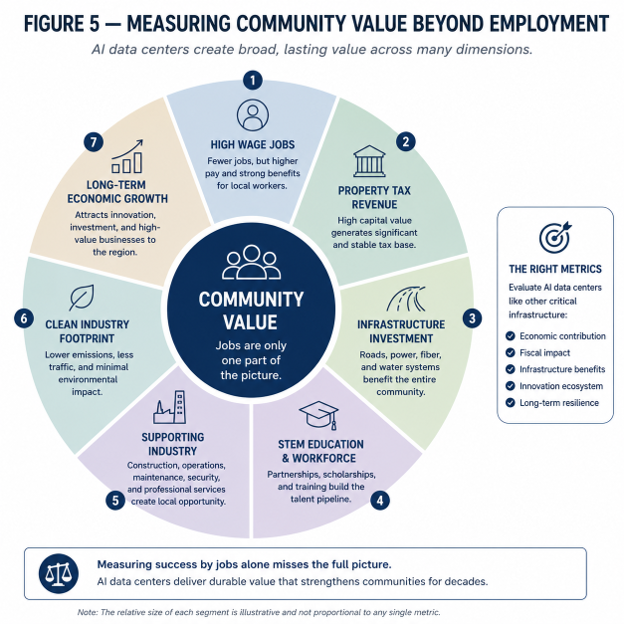
As the following sections demonstrate, that value extends well beyond permanent employment.
Direct Fiscal and Infrastructure Benefits
Once AI data centers are viewed as critical infrastructure rather than manufacturing facilities, a different set of economic questions naturally emerges.
Instead of asking only how many people work inside the facility, policymakers should ask what long-term value the facility contributes to the community.
This is precisely how communities have historically evaluated hydroelectric dams, nuclear generating stations, airports, ports, and other forms of essential infrastructure. Their value extends well beyond direct employment.
The same is increasingly true for hyperscale AI data centers.
High-Quality Employment
Although hyperscale AI data centers typically employ only a few hundred permanent personnel, those positions are among the most technically demanding in the local economy.
Operations engineers, electrical engineers, mechanical engineers, network engineers, critical facilities technicians, cybersecurity specialists, controls engineers, and facility managers are responsible for operating infrastructure that functions continuously with extraordinary reliability.
These positions generally command salaries well above regional averages and frequently exceed national median earnings by a considerable margin.16 Consequently, the economic contribution of a modern AI data center cannot be measured solely by the number of employees. The quality, stability, and earning potential of those jobs are equally important considerations.
The objective of economic development is not merely to maximize the number of paychecks. It is to maximize the long-term prosperity those paychecks create within the local economy.
A Long-Term Property Tax Engine
For many local governments, the most immediate and enduring benefit of a hyperscale AI data center is not its payroll but its contribution to the local tax base.
Modern AI campuses are among the most capital-intensive industrial developments ever constructed. Their buildings incorporate reinforced structural systems, redundant electrical distribution, substations, backup generation, advanced cooling systems, physical security infrastructure, and extensive communications networks.
Consequently, these facilities typically represent very high-value commercial real estate.17 In jurisdictions, where real property taxes are based upon assessed value, high-value improvements can translate into a significant long-term property tax base for local governments.
For county commissioners, school boards, and municipal leaders responsible for funding schools, public safety, roads, libraries, parks, and other essential services, this distinction is important.
A community should evaluate not only the number of employees working within a facility, but also the long-term fiscal value that the facility contributes over decades of operation.
Infrastructure Investments That Benefit the Region
Hyperscale AI campuses require some of the most robust infrastructure built anywhere in the country.
Serving these facilities often requires new electrical substations, transmission upgrades, expanded fiber connectivity, improved roads, and utility improvements.18
Although these investments are initially made to support the data center, they frequently strengthen the surrounding region’s infrastructure and improve its attractiveness for future commercial and industrial development.
Just as communities have historically benefited from hosting major transportation hubs or power generation facilities, AI data centers can accelerate infrastructure investments that improve regional competitiveness for decades to come.
Lower Population Growth Can Also Be a Fiscal Advantage
Economic development discussions often focus exclusively on employment growth.
Employment is undoubtedly valuable.
However, population growth also creates long-term demands for schools, healthcare, housing, roads, police, fire protection, and other municipal services.
Large labor-intensive developments frequently require communities to expand public infrastructure in parallel with employment growth.
Hyperscale AI data centers present a different economic model.
Because they employ relatively few permanent workers, they generally do not create the same level of sustained population growth associated with traditional manufacturing facilities or large distribution centers. Existing schools, hospitals, transportation systems, and municipal services are therefore less likely to require major expansion solely because of the data center.
This should not be interpreted as suggesting that fewer jobs are inherently preferable.
Rather, it illustrates that responsible economic development requires evaluating both sides of the fiscal equation: the revenue generated by a project and the public expenditures required to support it.
Viewed from this perspective, a development that produces a substantial tax base while placing comparatively modest demands on public services may represent an attractive long-term fiscal outcome.
Building an AI Infrastructure Ecosystem
The economic contribution of AI data centers extends well beyond the facility itself.
Communities that hosted power plants historically attracted engineering firms, maintenance contractors, equipment suppliers, technical consultants, and workforce training organizations that supported the broader energy sector.
The same opportunity now exists around AI infrastructure.
As regions develop concentrations of hyperscale AI data centers, they naturally become attractive locations for businesses specializing in mission-critical infrastructure.19
These include:
- Electrical contractors specializing in high-voltage systems.
- Cooling and HVAC specialists.
- Fiber optic construction and maintenance firms.
- Generator, battery, and power distribution companies.
- Engineering and commissioning consultants.
- Physical security providers.
- Specialized construction companies.
- Technical education and workforce development organizations.
Forward-looking communities can therefore think beyond attracting a single data center.
They can position themselves as regional centers of excellence for designing, constructing, operating, and maintaining AI infrastructure serving facilities throughout a much wider geographic area.
Beyond Taxes: Community Partnerships
The conversation should not end with tax revenue.
Communities hosting nationally significant AI infrastructure are well positioned to negotiate broader public benefits that create lasting value for residents.
Examples include investments in STEM education, community college partnerships, scholarships, electrical and HVAC apprenticeship programs, workforce development initiatives, public libraries, parks, broadband expansion, and innovation programs that prepare future generations for careers in the digital economy.
The objective should not simply be to maximize employment within the data center’s fence line.
It should be to maximize the long-term value that the investment creates for the community as a whole.
Cleaner Industry Has Value
Economic development has historically required communities to balance prosperity with environmental impact.
Heavy manufacturing often brought valuable employment opportunities but also increased traffic, industrial emissions, hazardous waste, noise, and long-term environmental liabilities.
Hyperscale AI data centers represent a different model of industrial development.
Once construction is complete, daily operations generate comparatively little traffic, no manufacturing emissions, no industrial by-products, and relatively modest demands on municipal services. Their economic contribution comes primarily through capital investment, high-skilled employment, property taxes, and digital infrastructure rather than continuous industrial production.
This does not imply that AI data centers have no environmental footprint. They require land, electricity, and responsible planning.
However, compared with many traditional heavy industries, they represent a substantially cleaner form of long-term economic development.
As economies continue transitioning toward knowledge-intensive industries, clean industry is itself becoming an increasingly valuable economic asset.20
Looking Forward
A century ago, communities debated where power plants should be built.
Those discussions often centered on land use, water, employment, and public investment. Over time, however, society came to recognize that the true value of power plants lay not in the number of people they employed, but in the electricity they provided to every other industry.
AI infrastructure represents a similar transition.
Just as power plants transform fuel into electrical capacity, AI data centers transform electricity into computational capacity.
Neither exists for its own sake.
Each exists because it enables the broader economy.
The industries of the twentieth century were built upon abundant electricity.
The industries of the twenty-first century will increasingly be built upon abundant computational capacity.
Communities that recognize this shift early will be better positioned to participate in the next generation of economic development.
Key Takeaways
- AI data centers create relatively few permanent jobs, but like other forms of modern critical infrastructure, their economic value is increasingly measured by productivity, capital investment, and long-term societal benefit rather than workforce size.
- AI data centers are more appropriately compared with power plants and other forms of critical infrastructure than with traditional factories.
- Communities should evaluate long-term fiscal value, including property tax revenue, infrastructure improvements, high-skilled employment, and ecosystem development—not simply jobs per acre.
- Lower permanent employment also means less pressure on schools, housing, healthcare, and other municipal services while maintaining a strong local tax base.
- Forward-looking communities can maximize value by attracting AI infrastructure support industries and negotiating educational and workforce partnerships that benefit future generations.
Conclusion: Building the Infrastructure of the Future
Every major technological transformation has required society to invest in new forms of physical infrastructure before the full benefits of that transformation became apparent.
The Industrial Revolution required factories, railroads, ports, and canals. The electrical age required power plants and transmission networks. The information age required fiber optic networks, communications infrastructure, and cloud computing platforms.
The emergence of artificial intelligence represents the next stage in that historical progression.
Like every technological revolution before it, AI requires physical infrastructure capable of delivering a new foundational capability to the broader economy.
Throughout this paper, three of the most common concerns surrounding AI data centers have been examined: water consumption, electricity demand, and economic value. Each concern reflects legitimate questions that communities should ask before hosting major infrastructure projects.
The evidence suggests, however, that many of today’s public debates are shaped by assumptions inherited from earlier industrial eras rather than by the engineering and economic realities of modern computational infrastructure.
From an engineering perspective, the challenge is not water itself, but the efficient removal of heat. Cooling technologies continue evolving in ways that weaken the historical relationship between computational growth and water consumption.
From an energy perspective, electricity is the essential input from which computational capacity is produced. Like every capital-intensive industry before it, hyperscale AI operators are increasingly investing in securing the long-term availability and reliability of that critical resource.
From an economic perspective, employment alone provides an incomplete measure of community benefit. Like power plants, airports, ports, and telecommunications networks, AI data centers are critical infrastructure whose value extends beyond the number of people working inside their fences.
These three discussions point toward a common conclusion.
AI data centers should be evaluated as the power plants of the future rather than the factories of the past.
This perspective changes the questions communities should ask.
Rather than focusing exclusively on permanent employment, communities may also consider:
- How will this investment strengthen the long-term tax base?
- What improvements to electrical, communications, and transportation infrastructure will accompany the project?
- Can educational partnerships and workforce development initiatives be created alongside it?
- Can the community become a regional hub for businesses that design, build, operate, and maintain AI infrastructure?
- How does the long-term value created compare with the public resources required to support it?
These broader questions better reflect how societies have historically evaluated other forms of foundational infrastructure.
None of this suggests that AI data centers should be developed without careful planning or thoughtful public oversight. Responsible stewardship of water resources, electrical systems, land use, and community interests will remain essential as computational infrastructure continues expanding.
Rather, the argument presented throughout this paper is that these discussions should be guided by an appropriate framework—one that recognizes both the costs and the long-term societal value of the infrastructure being proposed.
A century ago, communities debated where power plants should be built because electricity would become the indispensable utility of the twentieth century.
Today, communities are debating where AI data centers should be built because computational capacity is becoming an equally indispensable capability for the twenty-first.
History has repeatedly shown that societies willing to invest wisely in foundational infrastructure are ultimately the ones best positioned to benefit from the technological revolutions that follow.
The challenge before us is therefore not simply deciding where AI data centers should be built.
It is recognizing that they are becoming part of the physical infrastructure that will power the future.
References
McKinsey Global Institute, The Economic Potential of Generative AI: The Next Productivity Frontier (June 14, 2023); PwC, Sizing the Prize: PwC’s Global AI Study—Exploiting the AI Revolution (2017). [1]
American Society of Heating, Refrigerating and Air-Conditioning Engineers (ASHRAE), National Electrical Manufacturers Association (NEMA), and Pacific Northwest National Laboratory (PNNL), AI Data Center Energy Performance Framework (2026); ASHRAE Technical Committee 9.9, Thermal Guidelines for Data Processing Environments, 5th ed. (Atlanta: ASHRAE, 2021). [2]
ASHRAE Technical Committee 9.9, Thermal Guidelines for Data Processing Environments, 5th ed. (Atlanta: ASHRAE, 2021); American Society of Heating, Refrigerating and Air-Conditioning Engineers (ASHRAE), National Electrical Manufacturers Association (NEMA), and Pacific Northwest National Laboratory (PNNL), AI Data Center Energy Performance Framework (2026). [3]
American Society of Heating, Refrigerating and Air-Conditioning Engineers (ASHRAE), National Electrical Manufacturers Association (NEMA), and Pacific Northwest National Laboratory (PNNL), AI Data Center Energy Performance Framework (2026); Uptime Institute, Resiliency Considerations with Direct Liquid Cooling (2023). [4]
ASHRAE Technical Committee 9.9, Thermal Guidelines for Data Processing Environments, 5th ed. (Atlanta: ASHRAE, 2021). [5]
American Society of Heating, Refrigerating and Air-Conditioning Engineers (ASHRAE), National Electrical Manufacturers Association (NEMA), and Pacific Northwest National Laboratory (PNNL), AI Data Center Energy Performance Framework (2026); Uptime Institute, Uptime Institute Global Data Center Survey 2024 (July 2024). [6]
NVIDIA Corporation, NVIDIA Blackwell Architecture; American Society of Heating, Refrigerating and Air-Conditioning Engineers (ASHRAE), National Electrical Manufacturers Association (NEMA), and Pacific Northwest National Laboratory (PNNL), AI Data Center Energy Performance Framework (2026); Uptime Institute, Resiliency Considerations with Direct Liquid Cooling (2023). [7]
Alfred D. Chandler Jr., The Visible Hand: The Managerial Revolution in American Business (1977); Alfred D. Chandler Jr., Scale and Scope (1990).
U.S. Energy Information Administration, Annual Energy Outlook 2025 (Washington, DC: U.S. Energy Information Administration, April 2025); Federal Energy Regulatory Commission, Energy Infrastructure Update for December 2024 (revised data on April 22, 2025) (Washington, DC: Federal Energy Regulatory Commission, April 22, 2025). [8]
Google, 24/7 by 2030: Realizing a Carbon-Free Future (September 2020). [9]
U.S. Department of Energy, Pathways to Commercial Liftoff: Advanced Nuclear (March 2023); International Energy Agency, Electricity 2025: Analysis and Forecast to 2027 (Paris: International Energy Agency, 2025). [10]
U.S. Department of Energy, Grid Modernization Initiative; LevelTen Energy, LevelTen PPA Price Index. [11]
U.S. Department of Energy, Grid Modernization Initiative; National Renewable Energy Laboratory, Grid Modernization. [12]
OECD, The Future of Productivity; McKinsey Global Institute, The Power of One: How Standout Firms Grow National Productivity.
U.S. Department of Energy, Pathways to Commercial Liftoff: Advanced Nuclear (March 2023); Nuclear Energy Institute, Nuclear by the Numbers (August 2020); U.S. Bureau of Labor Statistics, Occupational Employment and Wage Statistics. [13]
Wisconsin Department of Revenue, Wisconsin Property Assessment Manual (2026); International Association of Assessing Officers, Property Assessment Valuation, 3rd ed. (Kansas City, MO: International Association of Assessing Officers, 2010). [14]
Wisconsin Department of Revenue, property assessment guidance; International Association of Assessing Officers (IAAO).
U.S. Economic Development Administration, Regional Technology and Innovation Hubs; Michael E. Porter, “Clusters and the New Economics of Competition,” Harvard Business Review 76, no. 6 (November–December 1998). [15]
Harvard Business School, Michael Porter on clusters; Brookings Institution reports on innovation clusters.
Organisation for Economic Co-operation and Development, The Future of Productivity (Paris: OECD Publishing, 2015); McKinsey Global Institute, The Power of One: How Standout Firms Grow National Productivity (May 6, 2025). [16]
American Society of Heating, Refrigerating and Air-Conditioning Engineers, National Electrical Manufacturers Association, and Pacific Northwest National Laboratory. AI Data Center Energy Performance Framework. 2026. [17]
ASHRAE Technical Committee 9.9. Thermal Guidelines for Data Processing Environments. 5th ed. Atlanta: ASHRAE, 2021. [18]
Chandler, Alfred D., Jr. Scale and Scope: The Dynamics of Industrial Capitalism. Cambridge, MA: Belknap Press of Harvard University Press, 1994. [19]
Chandler, Alfred D., Jr. The Visible Hand: The Managerial Revolution in American Business. Cambridge, MA: Belknap Press of Harvard University Press, 1993. [20]
Federal Energy Regulatory Commission. Energy Infrastructure Update for December 2024 (revised data on April 22, 2025). Washington, DC: Federal Energy Regulatory Commission, 2025. [21]
Google. 24/7 by 2030: Realizing a Carbon-Free Future. September 2020. [9]
International Energy Agency. Electricity 2025: Analysis and Forecast to 2027. Paris: International Energy Agency, 2025. [22]
International Association of Assessing Officers. Property Assessment Valuation. 3rd ed. Kansas City, MO: International Association of Assessing Officers, 2010. [23]
LevelTen Energy. LevelTen PPA Price Index. Accessed July 14, 2026. [24]
McKinsey Global Institute. The Economic Potential of Generative AI: The Next Productivity Frontier. June 14, 2023. [25]
McKinsey Global Institute. The Power of One: How Standout Firms Grow National Productivity. May 6, 2025. [26]
National Renewable Energy Laboratory. Grid Modernization. Accessed July 14, 2026. [27]
NVIDIA Corporation. NVIDIA Blackwell Architecture. Accessed July 14, 2026. [28]
Nuclear Energy Institute. Nuclear by the Numbers. August 2020. [29]
Organisation for Economic Co-operation and Development. The Future of Productivity. Paris: OECD Publishing, 2015. [30]
Porter, Michael E. “Clusters and the New Economics of Competition”. Harvard Business Review 76, no. 6 (November–December 1998). [31]
PwC. Sizing the Prize: PwC’s Global AI Study—Exploiting the AI Revolution. 2017. [32]
U.S. Bureau of Labor Statistics. Occupational Employment and Wage Statistics. Accessed July 14, 2026. [33]
U.S. Department of Energy. Grid Modernization Initiative. Accessed July 14, 2026. [34]
U.S. Department of Energy. Pathways to Commercial Liftoff: Advanced Nuclear. March 2023. [35]
U.S. Economic Development Administration. Regional Technology and Innovation Hubs. Accessed July 14, 2026. [36]
U.S. Energy Information Administration. Annual Energy Outlook 2025. Washington, DC: U.S. Energy Information Administration, April 2025. [37]
Uptime Institute. Resiliency Considerations with Direct Liquid Cooling. 2023. [38]
Uptime Institute. Uptime Institute Global Data Center Survey 2024. July 2024. [39]
Wisconsin Department of Revenue. Wisconsin Property Assessment Manual. 2026. [40]