







Skip to content

Contact us

    Talk to our Experts


    +1 920 303 0470
    info@smart-is.com 1302 S Main ST , Oshkosh , WI 54902-6518

    Change Management

    “The Only Thing That is Constant Is Change” – Heraclitus

    Any organization that is striving to do better is undergoing a constant change.  Managing this change and communicating it through the organization allows successful organizations to manage their growth and lack of it ends producing chaos.

    What is “Change”?  Understanding this will be the first step in managing the effects of change through the organization.  This paper will give a brief introduction into this topic.  The reader is encouraged to take this as a seedling and expand it based on their respective challenges.

    Any organization, big or small, is undergoing a constant change.  There are personnel changes due to growth or attrition, there are policy changes based on government regulations or internal audits, there are structural changes going on due to growth challenges or cost containment in a downsizing effort.  Regardless of the change or the need for the change, the successful outcome at the end is only when the change gets managed through its course both in how the change happens and how it gets communicated.

    Take for example a new hire into the organization.  Normally the new hire comes through HR, gets their paperwork done, and is now ready to work.  However, if HR had no prior knowledge of the new hire, a disruption occurs.  Similarly, HR send the person to the floor, but the supervisors were not ready to take them in, or training is not going to start for another week etc.  Organizations to meet this challenge generally employ a workflow system where every step triggers communications to respective stakeholders, sets up appointments and allows for time in their schedule to accommodate the change.

    Consider an organization that needs to downsize to meet the cost containment challenges.  An abrupt change without proper communication opens up the flood gates in the organization and people may start to leave in panic.  The same change when done with proper communication through the rank and file, and with managing the cost with buy in from various members of the organization allows to build confidence and good will with the employees and they can understand the need behind downsizing.

    I must stress here that the examples given above are for major changes in an organization and generally all organizations do a decent job in managing such changes.  The failure of proper Change Management is exhibited in a much smaller scale, that ends up costing the organizations a lot of money due to how widespread it gets.  I am talking about managing the change for Software and Hardware in an organization.  Strong control minded organizations deploy change control mechanism on every peripheral making sure no change can be made without a central approval process.  And when a change does occur, it is logged, and older versions saved.  Organizations that fail to put such strong controls end up having regular issues around their staff losing productivity due to non-standard setups and failed processes.

    In conclusion, I will stress that change management needs to be embraced and championed in an organization.  Always understand the “Human” aspect of change management and put good controls to manage this.  Remember that people make mistakes, and process and check points allow to catch these.  Next remember that no one can be above change management.  So, start enforcing it at the top and ensure compliance at all levels.  Change Management needs to be ingrained in every level of the organization.  When the need arises, communicate the change and explain it in a formal manner.  Understand the delicacy of the change and the impact it may have on a section of your population (especially if there can be cultural impact) and manage it accordingly. All changes need to be Ownership driven.  The ownership may transfer and the change progresses but must always have an owner.  All changes can take a side turn and produce unplanned results.  The key in Change Management will be to expect the unexpected and plan for it.  Create Contingency plans and put them into action as needed.  Lastly, remember that the change will be carried out by individuals in the organization.  We cannot remove the user component from this and the best way to manage this is good reinforcement strategy at individual level.  Organizations setup regular training sessions around change management, provide performance bonuses in recognition of good practices and conversely remove people standing in the way of change.

    Recent Stories

    View All
    Blog Feature Image
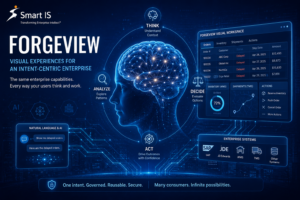
    ForgeViu: Visual Experiences for an Intent-Centric Enterprise
    Jun 12, 2026

    Technology has a habit of making us believe that every new breakthrough renders everything that came before it obsolete. When television became mainstream, many predicted the end of radio. When e-commerce emerged, some predicted the end of physical retail. When smartphones arrived, there were predictions that desktop computing would become irrelevant. Reality is usually more

    Read More
    Beyond the Crawl: A Coding Agent for Proprietary Programming Languages
    May 17, 2026

    General-purpose coding models perform well on languages that are well-represented on the public internet. They fail predictably on proprietary or domain-specific languages: hallucinated identifiers, wrong call shapes, and confident reproduction of deprecated patterns. MOCA, the scripting language inside Blue Yonder’s Warehouse Management System, is one of those failure cases, the entire ecosystem (grammar, command catalog,

    Read More
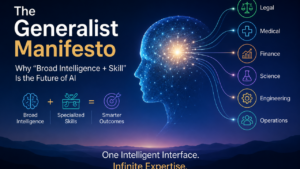
    The Generalist Manifesto: Why “Broad Intelligence + Skill” Is the Future of AI
    May 08, 2026

    For the past couple of years, we’ve seen a massive push toward Specialized LLMs. The argument seems intuitive: if you need legal expertise, use a legal model. If you need medical expertise, use a medical model. Why rely on a “general” model when you can have one trained specifically for the task at hand? In

    Read More
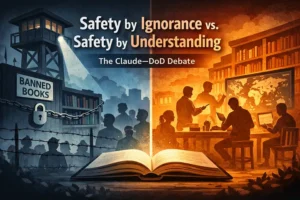
    Safety by Ignorance vs Safety by Understanding: What the Claude–DoD Debate Is Really About
    Apr 03, 2026

    There is a growing debate in AI governance that is often framed as a dispute over “safeguards,” “alignment,” or “responsible AI.” A recent flashpoint involves models developed by Anthropic (notably Claude) and the U.S. Department of Defense, but the disagreement is deeper than any single vendor or contract. At its core, the debate is not

    Read More
    From Chat to Capability: Operationalizing Enterprise AI Intents
    Apr 02, 2026

    In earlier posts, I argued two related ideas: This post builds directly on those ideas and takes the next logical step. If intent is the real abstraction — and if enterprises need repeatable, governed intelligence — then the obvious question is: Where does intent actually live, and how does it execute? The Missing Layer: Intent

    Read More
    Enterprise Cognitive Intelligence, Without the Complexity
    Feb 17, 2026

      In our previous post, we showed how our MCP framework removes the friction from exposing system capabilities to AI. MCP solves access. Cognition requires meaning. Because enterprises don’t think in systems.They think in business concepts. The Limits of System-Level Intelligence Most MCP servers today expose a single system — ERP, WMS, OMS, planning engines —

    Read More
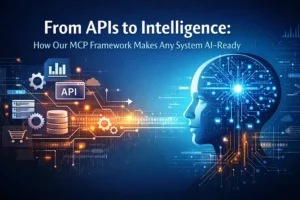
    From APIs to Intelligence: How Our MCP Framework Makes Any System AI-Ready
    Feb 17, 2026

    Everyone wants to “add AI” to their systems — but few succeed. Not because AI models aren’t powerful — they are. But because exposing enterprise systems to AI is still too hard. So for most teams, the friction is simply too high. A Useful Analogy: AI as a Researcher Think of AI as a researcher. At

    Read More
    F
    From System Silos to System Intelligence: The AI Shift Enterprises Cannot Afford to Ignore
    Dec 10, 2025

    Enterprises today operate in an environment where systems multiply, data sits fragmented, and real-time decisions depend on information scattered across platforms. The divide between organizations’ need for instant, secure, conversational access to enterprise intelligence and their reliance on siloed screens, complicated integrations, and manual reporting processes is increasing each year.   According to a survey report

    Read More
    Why Traditional Deployment Playbooks No Longer Keep Up with Modern Warehouses
    Oct 30, 2025

    Modern warehouses are evolving faster than the deployment practices that support them. What was once a predictable, linear, and manual deployment cycle has turned into a complex, high-stakes process that no longer fits the pace of operations. Traditional deployment playbooks were designed for slower systems with fewer moving parts. Today’s warehouses operate across multiple sites,

    Read More
    The Hidden Cost of Screen Development in Warehouse Reporting and the Solution
    The Hidden Cost of Screen Development in Warehouse Reporting and the Solution
    Oct 16, 2025

    Reporting sits at the core of every warehouse operation. It is the lens through which leaders make decisions, monitor performance, and anticipate challenges. Yet, behind the charts and dashboards lies a process that is often far more complex and costly than it should be. Screen development in warehouse reporting has become a silent drain on

    Read More